
The Weekly Insight Podcast – Patience Is Wearing Thin
Earnings season is in full swing. And amidst all the other things happening – oil spiking on more conflict in Hormuz, a Fed meeting this week – the big names started to come to the table with their results.
Through good results or bad, the Magnificent Seven has been the biggest game on Wall Street for the last three years. One only needs to turn on CNBC to understand the scale of their importance to the market. And so, their earnings reports – and how they’re received – matters dearly to the bigger picture.
That’s why on Wednesday, Alphabet’s (GOOGL) quarterly earnings report was so carefully watched. They had a tremendous quarter. Cloud revenue came in at $24.8 billion – up 82% year-over-year. Revenue beat expectations, coming in at $119.80B vs. $116.93B expected.
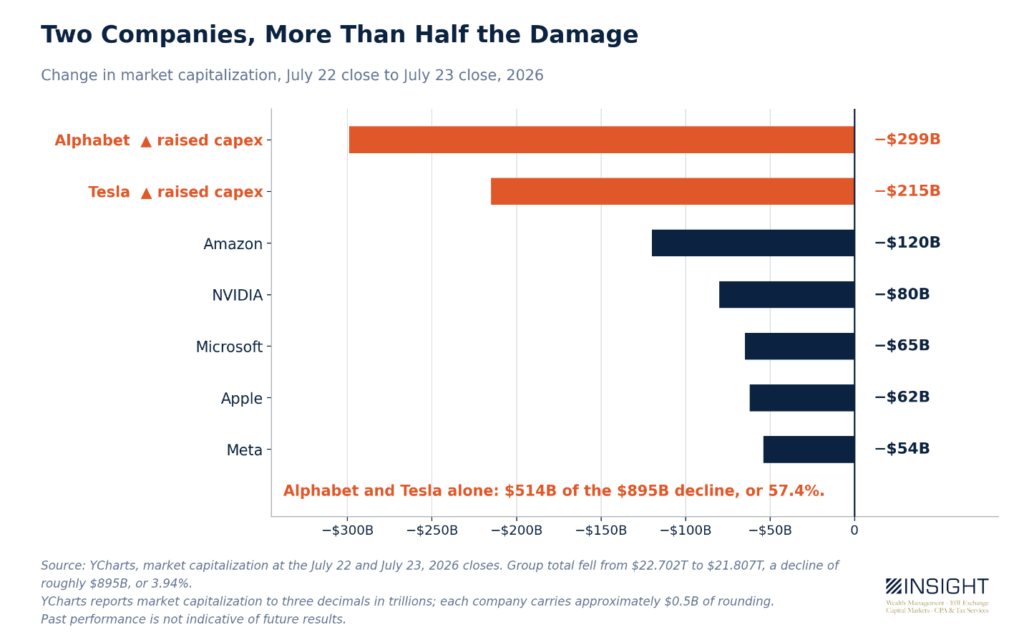
The market didn’t care. The stock was down 7.13% over the next 24 hours. They lost $299 billion in market capitalization.
Were We Right?
Two weeks ago, we sent you a memo (When Optimism Becomes a Risk) that predicted this moment. And the easy thing to do would be to claim victory. As we projected at the time, earnings misses – against highly raised expectations – would be punished. Despite an amazing operating quarter, Alphabet did slightly miss the Wall Street earnings mark, coming in $0.04 below the $2.89 per share expected.
But that is not actually what happened this week. We were right on the asymmetry. But we missed the mechanism. And the mechanism is especially important to what may happen in markets this week.
What Actually Happened
The market has expected one thing from the AI Hyperscalers for the last few years: scale. Go out and build it. And the big boys are not shy about accommodating. Capex amongst the Magnificent Seven has been, frankly, obscene over the last few years. They are numbers an investor from 10 or 20 years ago could not comprehend.
Alphabet continued to deliver on that promise this week. Capex in Q2 was $44.9 billion. But even more importantly, they raised their guidance on full year 2026 capex. What had been $180 – $190 billion has now jumped to $195 – $205 billion. To put this in perspective, the high end of that range is just slightly below the nominal GDP of Qatar (IMF, April 2026).
Alphabet wasn’t the only one reporting. Tesla also reported on Wednesday. They had record Q2 deliveries and operating cash flow was up 85% year-over-year. But their capex is expected to exceed $25 billion – and they announced new borrowing capacity of $30 billion. Their stock was down 14.52% over the next 24 hours.
The Problem Is the Payback
The problem is not the cost. It is not even the massive borrowing. The real problem is that investors like to know what’s in it for them. How can they make money by investing their hard-earned dollars in these companies? How do these investments return profit to investors?
That is the question these companies are struggling to answer today. When Alphabet CFO Anat Ashkenazi was asked this question, she suggested that Alphabet will continue to invest “as long as we see an attractive return on that investment.” Tesla said capex would continue to grow for another “two or three years.” Amazon’s AWS investment won’t monetize until 2027 or 2028. OpenAI isn’t expected to turn a profit until 2030.
But those are all bets on the future. And Wall Street can run a discounted cash flow. With interest rates looking to be on the rise, those bets do not look as good as they did a year ago.
The Proof Is in the Results
Alphabet and Tesla reported last week. But the concerns the market expressed over those two companies stretched to the entire Magnificent Seven. Those seven names lost $895 billion in market capitalization the day after the earnings calls. Read that again: seven companies lost $895 billion in market value in one day. They were down 3.94%.
Past performance is not indicative of future results.
But the real tell wasn’t Thursday. The real story goes all the way back to last year. We have been talking for a while about the rebalancing happening in the market. The shift has been dramatic and has benefited investors who were in front of it. But we are not at the closing chapter yet.
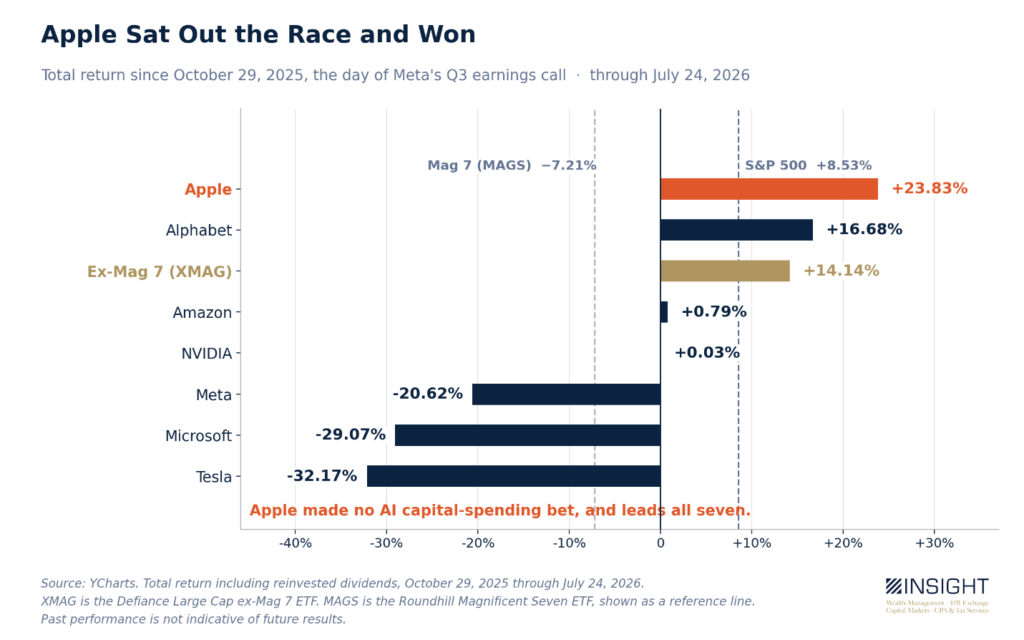
The story goes back to what we talked about with Meta’s Q3 2025 earnings call. They – like Alphabet this week – had a great quarter. But like Alphabet, the market punished them for their growing capital expenditures. That trend has continued since. Only Alphabet and Apple have outperformed the broader market since that report.
Past performance is not indicative of future results.
But now Alphabet has put themselves in the same situation. Only Apple is the real outlier. Just as it was this week. Yes, it suffered on Thursday. But by Friday, they were up strongly from their Wednesday close.
Why? They have been the one Magnificent Seven company to make the counter bet: they are NOT spending on AI infrastructure. Their capex is not exploding. And the market is rewarding them.
This Is Not Over Yet
The pain we saw last week was from 23.5% of the Magnificent Seven (by market cap) reporting. This week we have 53.6% releasing their results. Amazon, Apple, Meta, and Microsoft all report earnings this week.
The real collision is on Wednesday. At 1:00PM CDT, the Federal Reserve will announce their interest rate decision. At 1:30PM CDT, Fed Chairman Warsh will step to the podium and discuss their decision and the future. After the market closes, Microsoft and Meta will report their earnings.
For Meta to reach its stated goal for infrastructure spend this year, they must average over $38 billion per quarter in Q2, Q3 and Q4. That’s a 94% increase in the rate of spending over Q1.
Analysts previously put Microsoft’s FY 2027 capex expectations at $130 billion. BNP Paribas is now suggesting the number could be $262 billion.
Amazon capex is pacing above $200 billion for this year. How high will it go?
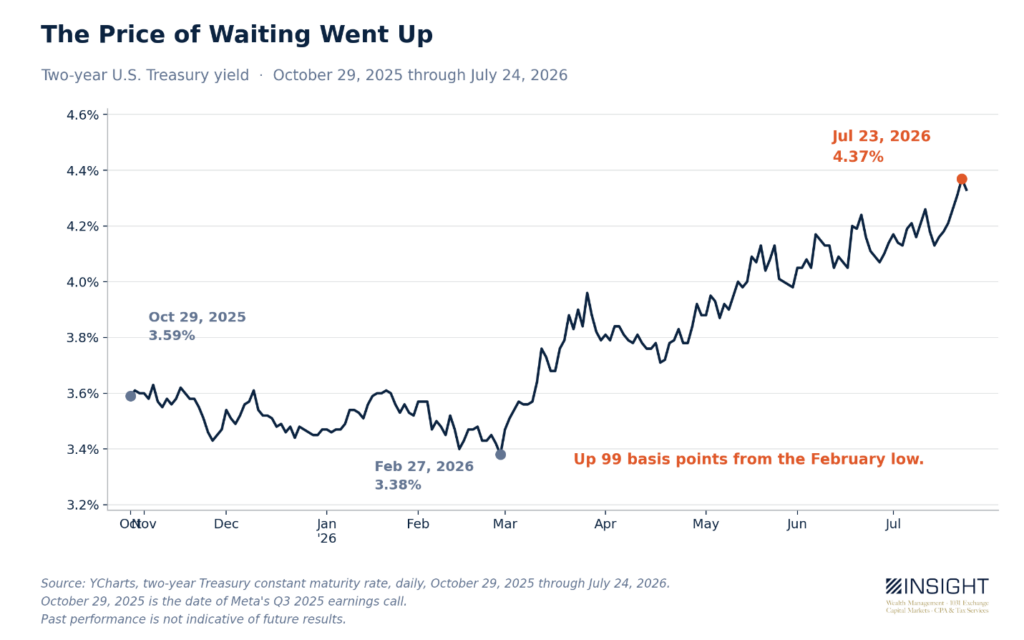
And all of this in the face of a bond market expecting higher and higher interest rates. Going back again to October 29th of last year, look at what has happened to 2-year Treasury yields since that Meta call.
Past performance is not indicative of future results.
A 78 basis point move in nine months. 99 basis points off the low in February. That means the cost of waiting on the results from this infrastructure spend is going up. Run that through a discounted cash flow and a dollar of profit eight years from now loses roughly 6% of its present value. Nothing has changed about the businesses. Only the wait got more expensive.
That will test the market’s patience, especially if Warsh plays the hawk on Wednesday. The market thinks he will. Odds of a July rate hike jumped over the last two weeks to 38%. A September rate hike is now the expected outcome with 82% odds.
What the market is grading has changed. Wednesday will tell us whether this new path is holding. And Thursday will be the counter argument. Will Apple – without their infrastructure spend – be rewarded for their restraint?
The plan Alphabet and others are executing right now is clear: the world is changing and we need the computer infrastructure in place to manage that shift.
That is not an illogical approach. In a supply constrained market, buying capacity early is rational. And Alphabet’s earnings call made the point this week: Cloud revenue is up 82% year-over-year. They see something coming.
But that does not make the market wrong. Investors want a path to payback. And that cost Alphabet $299 billion in market capitalization on Thursday.
The buildout may be entirely right and still be worth less than what investors were valuing it at a few months ago. What changed isn’t the strategy. It’s the price of patience. At these valuations, with this amount of spend, and rising interest rates – that patience is clearly wearing thin.
Sincerely,