

The Weekly Insight Podcast – Raising Investors
We had a remarkable experience this weekend that got us thinking. Before we dive in, let us set the table.
Insight has a client – let’s call him Steve (*names have been changed to protect the awesome!) who has been with the firm for a long time. Like many of you, he and his wife have worked hard to build a legacy over the last 30+ years. But there was something bugging him: it’s one thing to give your heirs money but it is another entirely for them to know how to handle it when they receive it.
And so, Steve developed a plan. He called it the “Family Investment Challenge.” He included his two children, their spouses, and four nephews. Eight “kids” in their late 20s and 30s. He then opened eight accounts for them at Schwab – joint accounts where both he and the participants had access – and funded each account with $10,000.
And then the challenge began. Three years. Whatever they made in the account was theirs and Steve would pay the taxes. But it was also a competition (who doesn’t get excited by a competition?) and the top three took home prizes on top of their “winnings.”
Over the next three years they held regular meetings. They allowed us to take part and provide thoughts on investment strategies, economics, and market trends. And on Friday, the three years were up. The winners were announced on Saturday (the top two were separated by less than $100!). Each participant made money – with some very impressive returns.
But the fascinating thing about Saturday’s final meeting was not the results. It was the things these “kids” were now thinking about. They understood how the market actually works. They were paying attention to the financial world around them. They were thinking more deeply about their financial future.
It won’t be a cheap challenge for Steve. He is going to have sizeable capital gains taxes to pay. But the experience with his family was invaluable. And it reminds us of so many conversations we have with clients about how best to engage their kids and grandkids financially.
It was the conversation that Steve started which was so valuable. His audience was much older. Many of you have kids and grandkids who are much younger, but the conversation is just as important. And there are tools available today which allow you to engage that conversation in a meaningful way – both educationally and financially.
So today we want to discuss a few common – and a few new – tools to think about as you engage young people on finances. They don’t have to cost $80,000 to start up, but they can be invaluable tools down the road.
For the Youngsters: Chore Tracking to Payment to Investment Tools
Chores and allowances have long been the first way young people begin to understand the value of money. “I did a job. That got me money. That money bought me goods.” It is the basics of capitalism for the uninitiated.
But as technology has advanced there are new tools our clients are using that have fantastic utility. One we have seen used is Greenlight (full disclosure: this is NOT a recommendation of Greenlight!).
Their app allows you to take the chores to allowance loop one step further. It allows kids to track their chores and parents to make payments directly in the app. But it then allows the kids to utilize three different “accounts” in the app: a debit card linked to a “Spend Any Time” account, an interest-bearing savings account, and an investment account that allows the kids to buy real shares of equities, mutual funds and ETFs.
Greenlight does cost money. And various tiers get you added tools. But an app that allows kids to see their money, spend (wisely), and learn the value of saving and investing is powerful. It’s designed so even very young children can use it.
Building – and Protecting – Credit
Learning about building a credit score is VITAL for young people. How many of us know someone who made the mistake of snatching up that credit card offer so many college freshmen get without understanding how to use a credit card? The damage created to their credit file can be long-lasting.
But did you know that children can start building a credit file much before then under adult supervision? Some credit card providers – American Express for example – will allow you to put your child on your account at age 13. They will receive their own card, but you will be able to watch spending. The timely payment of the account (usually by the parent) can help create a positive credit file for the child out of the gate.
But that is not the only issue. Child identity theft is a real thing. The bad guys get ahold of a Social Security number that no one is watching and can do real damage to a credit file before your youngsters get a chance to get started. That’s why it’s smart to lock a child’s credit file at the three big firms (Equifax, Experian, and TransUnion).
The tricky part? The Big Three might not even have the kid on file yet. If they haven’t tried to use credit, they “don’t exist” to those who keep credit scores. So, getting them on your account and then locking the credit file can be a great path to take.
Timing of Contributions – An Opportunity for Parents & Grandparents
As the saying goes, there are three big factors in properly saving for retirement: time, contributions, and investment returns. The first two are often the most important.
Take the example below: Sam starts putting $5,000 per year into an account at 18 and does so for 10 years. Jordan doesn’t start until age 28. Jordan puts $5,000 per year into an account each year until they retire (age 65). If they both have the same rate of return (7% per annum), who do you think wins?
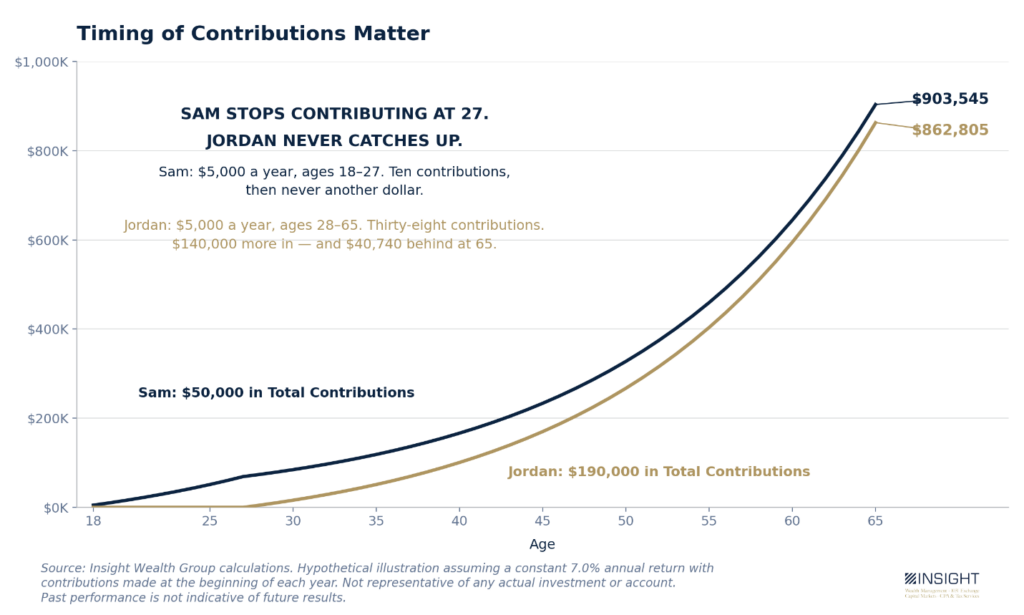
Past performance is not indicative of future results.
Getting started early really does matter. You can give your kids and grandkids a BIG leg up. But the tools you use to do so matter. Let’s run through some common ones.
529 Accounts
The original “Save for College” accounts, 529s have both added some new features and gotten a little less attractive.
The key benefit of a 529 – as they are administered by states – is that you can enjoy state income tax deductions for the contributions. That benefit – especially in states like Iowa – is getting smaller as state income taxes have shrunk. For example, a donor to an Iowa 529 just a few years ago could have reduced their state income tax by 8.53%. Today it is just 3.8%.
The main criticism of 529 plans – that they have no benefit beyond college education – has been addressed on both ends. First, 529s can now be used to pay for private K-12 education, expanding the value of the structure. But, more importantly, 529 beneficiaries can now roll up to $35,000 of unused 529 funds into a Roth IRA (subject to specific rules which you can find here). That’s a huge improvement. And a fantastic way to help your kids or grandkids get started on retirement.
UGMA/UTMA Accounts
Another common strategy to get kids started is a Uniform Gift to Minors account or its cousin, the Uniform Transfer to Minors account. Simply put, this is an account where you can gift an unlimited amount of funds (subject to gift tax rules). The donor can control and invest the funds until the child reaches majority age.
There are some (small) tax benefits for the account. For example, the first $1,350 of earnings are tax-free. And the next $1,350 are taxed at the child’s tax rate. That’s great, until the account makes more than $2,700. Then the account is taxed at the parents’ tax rate. And that can be painful.
The bigger problem with UGMA/UTMA accounts is control. As noted above, at 18 (in most states), the child now gains full control of the account. But this is not a retirement account. There are no penalties for liquidation, and the money is not locked up. How many 18-year-olds make great decisions when receiving access to large sums of capital?
530A IRA/Trump Accounts
The newest player on the block are “Trump Accounts” or, as the IRS calls them, 530A IRAs. And they are worth a hard look for those hoping to help children in their lives establish a retirement plan.
The big headline on the Trump accounts was the “$1,000 per kid” from the federal government. It’s real – but not that big of a deal. It only applies to children born between January 1, 2025, and December 31, 2028. So, if you have older children, there is no cash benefit. But that does not mean you should ignore these accounts.
Trump accounts are – in reality – just IRA accounts that don’t require earned income to fund. And they can be funded by others (i.e., parents & grandparents). Contributions are limited to $5,000 per year and can be made until the child reaches age 18.
Until that point, there are NO withdrawals allowed. A normal IRA allows withdrawals with a penalty. In these accounts there is no way to get the funds out.
At age 18 they start to act like any other IRA.
But that is where it gets interesting. Because these are Roth conversion eligible. And only the earnings are taxed upon the conversion.
Let’s look at Sam and Jordan again. But instead of the last outcome, Jordan’s parents did ten years’ worth of Trump account contributions. Sam does what Sam already did. Look at the massive difference. And neither contributes past their initial $50,000.

Past performance is not indicative of future results.
Yes, the Roth conversion is taxable. And like the UGMA/UTMA, if the child is still a dependent, anything over $2,700 is taxed at the parents’ tax rate.
But imagine the ability to ensure your child or grandchild had nearly $1.8MM by the time they retired. All for $50,000 up front. It’s quite a compelling idea. And one more thing: at age 18, Jordan is converting $73,918. That entire amount would also be eligible to be pulled to pay for college if it is needed. So, you are funding potential college needs while also preserving the possibility of significant retirement savings. College funding pulls from the retirement benefit, but it gives you optionality.
Operationally, however, Trump accounts are still…being figured out. The only place you can open one today is via the government’s preferred vendor: Robinhood. And, for the time being, the accounts must stay there. It is our understanding that groups like Schwab are working with the Treasury Department and will be set up to receive 530A transfers soon.
There are many options available to parents and grandparents. But, as “Steve” showed us over the last three years, the most important tends to be the conversation. Getting kids to talk about money and learning how things work is vitally important.
And we are always here to help when the time is right. These planning conversations are some of our favorites. Having the opportunity to impact young people before they have to dig out of a hole is better for everyone. If you would like to discuss your options – and what might be best for your situation – we would be excited to go through it with you.
Sincerely,