

The Weekly Insight Podcast – The Lie We All Agreed To
Editor’s Note: This week is a big week in Iowa. It’s time for RAGBRAI – the Register’s Annual Great Bike Ride Across Iowa. Several thousand slightly crazy people will hop on their bikes and brave the Iowa heat to ride from the Missouri River to the Mississippi River and throw a gigantic party along the way.
If you are going this year the route is going right in front of our satellite office on Main Street in Panora, Iowa. We will be the first building you see on Main Street. And we will be handing out free bananas (cramps are bad!) and collecting free will donations for the Panora Schools. We hope you’ll stop by and say hi!
Something happened two weeks ago that has not happened in a long, long time: The President of the United States addressed alternative plans to fix Social Security.
“Australia has a thing going that’s very good…We’re looking at that very strongly.”
– President Donald J. Trump, July 6, 2026
To be fair, it was a casual comment at a Rose Garden speech addressing children’s savings accounts (more on those in the weeks to come…it’s a good program for parents and grandparents). It was not a formal policy proposal. But it was the first time a President of the United States publicly floated an alternative to the current structure since 2005.
As they say, admitting you have a problem is the first step.
So, what is this Australian program he’s talking about? To put it simply, Australia has a compulsory system where 12% of wages go into an account which is invested by funds across equities, property, infrastructure, and more. That account – an individual account – is then used to provide retirement benefits upon reaching retirement age. It is working for Australia. The difference is they fixed their system 30 years ago before it was too late.
The Math Is Getting Worse
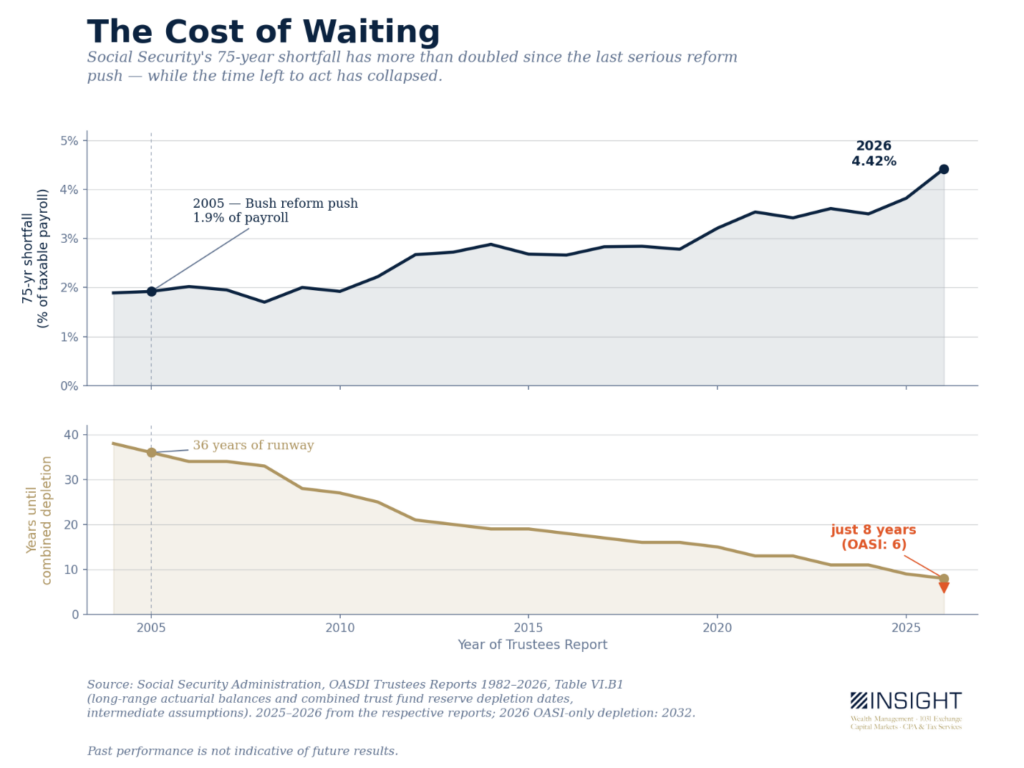
Each June we get a report from the Trustees of the OASI and OASDI Trust Funds. The latest report just came out. And it isn’t pretty. The OASI Trust Fund (the main one) runs out of money in 2032. Benefits will be cut – across the board – by 22%.
We wrote about this in depth when the report came out in 2024. You can read our comments at the time here: Weekly Insight: The Math Doesn’t Lie.
At the time, the OASI Trust Fund was set to run out of money in 2033, and the benefit cuts would be 21%. Since then, it has gotten a year earlier and a percentage point worse.
The Lie Everyone Agreed To
As we said at the time: math doesn’t lie. But we have all been lying to ourselves about Social Security for a long time.
Social Security – as a system – is not a retirement plan. In fact, the names of the two accounts that hold the funds tell us exactly their purpose.
OASI: Old-Age and Survivors Insurance
OASDI: Old-Age, Survivors, and Disability Insurance
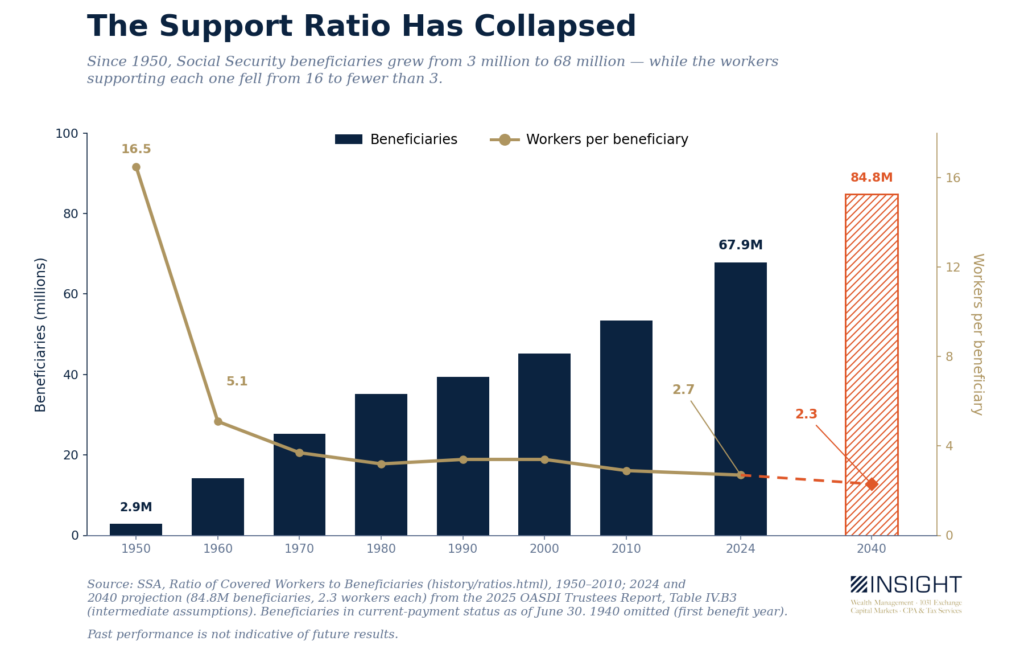
Social Security is an insurance program primarily meant to provide a benefit for people who are old or disabled. It wasn’t designed to bear the weight of an aging (and much healthier) population. In 1950 there were over 16 workers to each beneficiary. Today it’s 2.7. Those who reached 65 in the early years collected 13 years of benefits. Today, beneficiaries receive benefits for – on average – 20 years.
Past performance is not indicative of future results.
Yet, right there on your Social Security statement, they call them “retirement benefits”. And we’ve only raised the retirement age to 67!
So, there is the first lie: “retirement benefits.” Politicians have been talking about it for years. Americans have been treating it as a retirement savings program. It isn’t.
But the bigger lie is the one all the politicians have agreed on for over 20 years. Here’s just a sampling of what they’ve said:
“As President, I will protect Social Security…protecting middle class families from benefit cuts, tax increases or increases in the retirement age.”
– President Barack Obama
“I will protect and preserve it (Social Security).”
– Senator John McCain
“I will not cut benefits.”
– Senator Hillary Clinton
“If anyone tries to cut Social Security or Medicare, or raise the retirement age again, I will stop them.”
– President Joe Biden
“As President, I will not cut one penny from Social Security or Medicare.”
– President Donald Trump
“Raising the minimum age for Social Security is not under consideration.”
– Vice President Kamala Harris
This is not a partisan issue. The major candidates – and nearly all their members of Congress – have been lying to the American people about it since 2005. Why? Because the last politician that tried to fix it – George W. Bush – was crucified for doing so. And – if we are being blunt – his plan wouldn’t have worked anyway.
The facts, however, are the facts. We have wasted 20+ years, and the problem is just getting worse. A bad plan then would have been better than no plan until now.
Past performance is not indicative of future results.
Every Exit Is Now a Toll Road
President Trump alluded to the Australian system when asked what we are going to do about Social Security. It’s not an illogical place to go. The Australians identified the problem more than 30 years ago and adjusted to make sure they had a workable solution.
But we have passed the point of making that work. Executing the Australian system right now would take an extra $1.3 – $1.5 trillion per year for decades. It would require doubling the payroll tax to execute. When was the last time a 12%+ tax increase made it through a divided Congress?
Trump, however, deserves credit for having the conversation. So, too, do Democrat Senator Elizabeth Warren and Republican Senator Bernie Moreno. They came together earlier this summer with their proposal to fix Social Security which called for eliminating the cap on wages taxable for Social Security (currently at $184,500). That would raise $3.4 trillion over the next 10 years but only closes half the gap. Unsurprisingly, they were eviscerated by their own parties for proposing the change.
The reality is we have three choices: tax more, borrow more, or cut benefits. None will be popular.
Social Security Is Just the Symptom
We keep hearing the same thing when we ask folks about what is next for Social Security: Washington will kick the can down the road. It is a fair assumption since they’ve done that for a long time now!
But kicking the can doesn’t do much. The first thing they will do is combine the OASI fund with the healthier Disability Insurance Trust Fund. But that will only buy us two more years of full benefits and slightly shrink the overall benefit cut to 17%.
Beyond that, it gets to the big three: benefit cuts, tax increases, and more borrowing. It doesn’t take a political strategist to understand Washington will probably pick the borrowing.
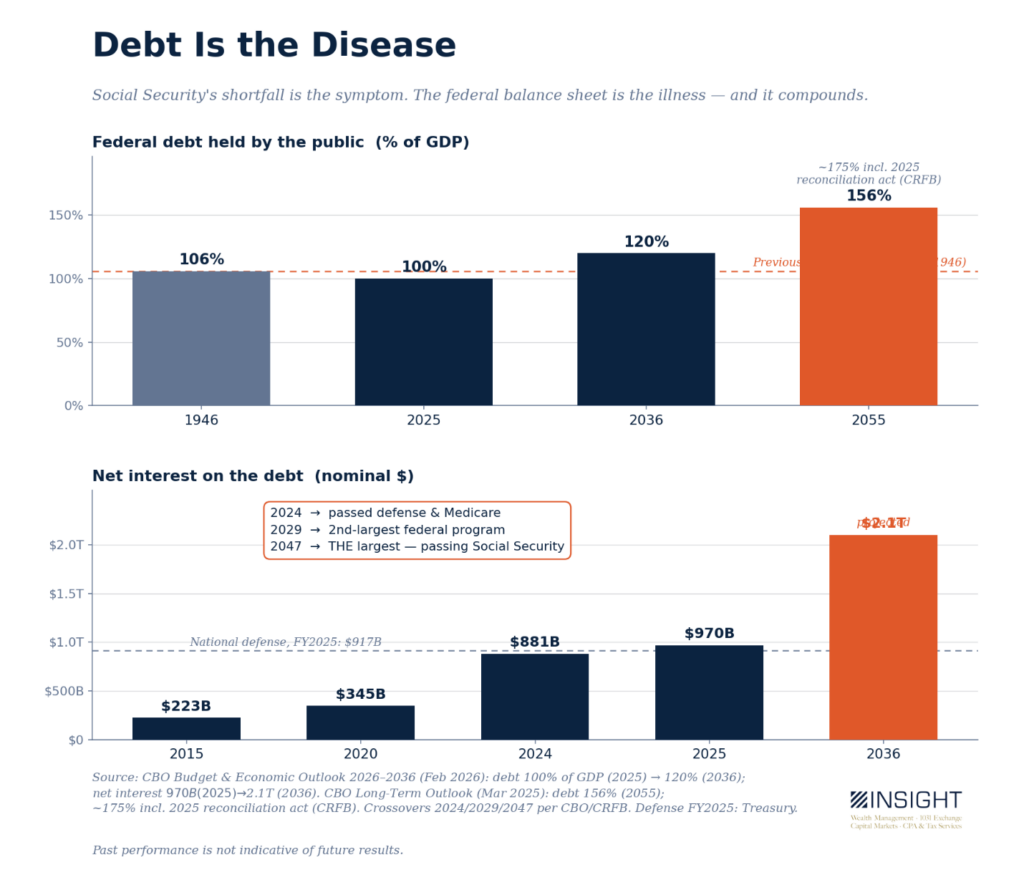
The borrowing is the much bigger problem. Social Security is just the issue that will finally make it plainly obvious. The same demographic math that breaks the trust fund in 2032 is also driving us to places we’ve never seen before with the Federal Debt.
The debt-to-GDP ratio is now 100% – the highest it has been since World War II. It’s on pace to hit 120% by 2036. Interest on the debt – $970 billion in 2025 – has now surpassed defense spending as an annual amount. It will become the largest annual federal expense in 2047. And that’s all before any new debt gets added to shore up Social Security benefits.
Past performance is not indicative of future results.
It is not sustainable. Anyone with common sense can see that. Which means, in the end, American taxpayers will eventually be dealing with tax increases and/or cuts to government programs – including those like Social Security.
What It Means for You
We can call out the craziness all we want – but what it means for you the taxpayer, the Social Security beneficiary, the investor is what matters most.
For lower income earners, the benefit cuts will hurt. A lot. If you are living off $35,000 in Social Security, you don’t have $7,000 worth of cuts to make in your budget.
For most of our readers, the benefit cut won’t be the end of the world. But the bill that comes due may be more impactful. Higher marginal tax rates, higher Treasury rates so Washington can attract investors, lower growth as the government struggles to fund programs beyond interest payments? All are possible. And all will be paid for by people like you.
“Washington will fix it” is not a plan. It’s hoping, not positioning.
Until they do something, we can’t make Washington stop lying about this. But we can choose to plan around it with the variable you control: your savings, your investments, and your financial planning.
Sincerely,