
The Weekly Insight Podcast – The Fed Didn’t Hike Rates. The Market Did.
Volatility continues to impact the market – both good and bad – as traders negotiate the impact of many competing forces. Last week reminded us of a few years ago: a pressure packed policy week highlighted by a decision on interest rates from the Federal Open Markets Committee (FOMC).
As regular readers know by now, Wednesday was not Chairman Kevin Warsh’s first rodeo. He stood in front of the press and announced interest rate decisions in both June and July. But this was the first meeting when the market expected the Fed to do something instead of holding rates steady.
Before we dive into this meeting – and what the rate hike decision means –let’s reset the stage.
First, we must remember that Warsh was President Trump’s answer to Jerome “Too Slow” Powell. Of all the President’s nicknames, we might agree most with this one! But, at the time, we were a bit astonished by the pick.
As President Trump said at the time, he wouldn’t have chosen Warsh if he wanted rate hikes. Yet, at the time we noted this about Warsh:
“Warsh was not the consensus pick…Investment News called his nomination a ‘somewhat hawkish surprise’ and Bloomberg said Warsh is ‘likely to resist balance-sheet expansion…The key variable to watch: will the Administration attempt to override Warsh’s hawkish history once he’s confirmed in May? The question is whether Warsh will maintain his long-held positions or shift to the administration’s preferred path of rate cuts and dollar weakness.”
And then Warsh took the podium for the first time in June. He promised many (long-needed) changes at the Fed. One of the most important was the end to the (as we deemed it in 2022) the “circular sentiment firing squad”. Too often the Fed and the market get into a doom loop and start chasing each other’s expectations. Warsh called it out:
“I think financial markets perform best when they react to incoming data. (They) work less efficiently when they ask a question: How will the Federal Reserve react to that incoming information…when all the financial markets are doing is reflecting back what we’ve said, then we’re taking the most important source of information and being blind to it.”
That was all well and good until recently. Then the market started weighing in on rate hikes. By close of business last Tuesday, the market had priced in an over 90% chance the Fed would raise rates. And the message from the financial press was clear: if the Fed didn’t deliver a rate hike, it would be unwelcome news. Bank of America’s Alex Cohen was quoted as saying “With a hike about 90% priced, it would be nearly unprecedented for them to hold at this stage.”.
Do you see it? The Fed didn’t hike rates! The market did. It started by raising the 10-year Treasury yield to over 5%. And then it priced a rate hike in so aggressively that if the Fed didn’t deliver a rate hike, it would necessitate an aggressive correction.
So, Warsh delivered. And then he stepped to the podium and went back to his original talking points. It was a quick press conference (nearly 40% shorter than the average Powell presser). Reporters were only allowed one question and no follow-ups. He wouldn’t provide any guidance or any of his own personal thoughts on the economy. All very much in keeping with what he talked about in June and July.
But the result was still the same. The market wanted a hike. The market got a hike. Who’s really in charge?
Hiking Into an Oil Price Spike
The more important thing coming out of this session wasn’t the reversion to the Powell playbook. It was, instead, the decision to chase after inflation at this moment.
Yes, inflation is elevated. At least above the 2% mandate the Fed currently has. The biggest driver of this inflation today is the price of oil and its impact on nearly all products American consumers purchase.
If oil is the issue, there are two things we can do to get the price back down: get more oil to market or significantly reduce demand for it.
As you’ve heard, the chances of getting more oil to market continue to diminish by the day. The closure of the Strait of Hormuz was always going to be a problem. But the Saudis and others had rerouted a significant amount of oil to the Red Sea, bypassing the Strait. The Houthis slammed the door on that quickly by mining the entrance to the Red Sea and attacking the Saudi East-West Pipeline that was doing most of the work on the bypass. The impacts to supply are adding up.
If you remember your Econ 101 coursework, it has a lot to say about supply and demand. What’s the next solution if you can’t impact supply? There’s only one other place to go: reduce demand. How do you reduce demand for the primary energy source in the world? Slow economic growth. Which is exactly what rate hikes do.
Warsh made a nod to this – but didn’t address it directly. As he said at the podium, uncertainty is
“elevated, owing in part to geopolitical developments.”
Richard Escobedo, a reporter at the press conference, asked Warsh the question more bluntly. His question:
“…A quarter point rate hike does not reopen the Strait of Hormuz. And so, I wonder how you think these smaller rate hikes will be effective when it can’t necessarily address the energy-supply side of inflationary pressures.”
Warsh, in keeping with his pledge not to forecast, punted on the question.
This isn’t the first time policy makers have tried to manipulate rates in the face of an oil shock. It happened during the Arab Oil Embargo, the Iranian Revolution, and the 1990 Gulf War.
All three included at least a doubling of energy prices (1973 saw a quadrupling) which we haven’t seen yet. Brent crude is up 42% since the start of the War.
Twice the Fed raised rates. Once the Fed cut them (1990 Gulf War). All three ended in a recession. But the Gulf War recession was the least impactful, becoming one of the shortest recessions since World War II.
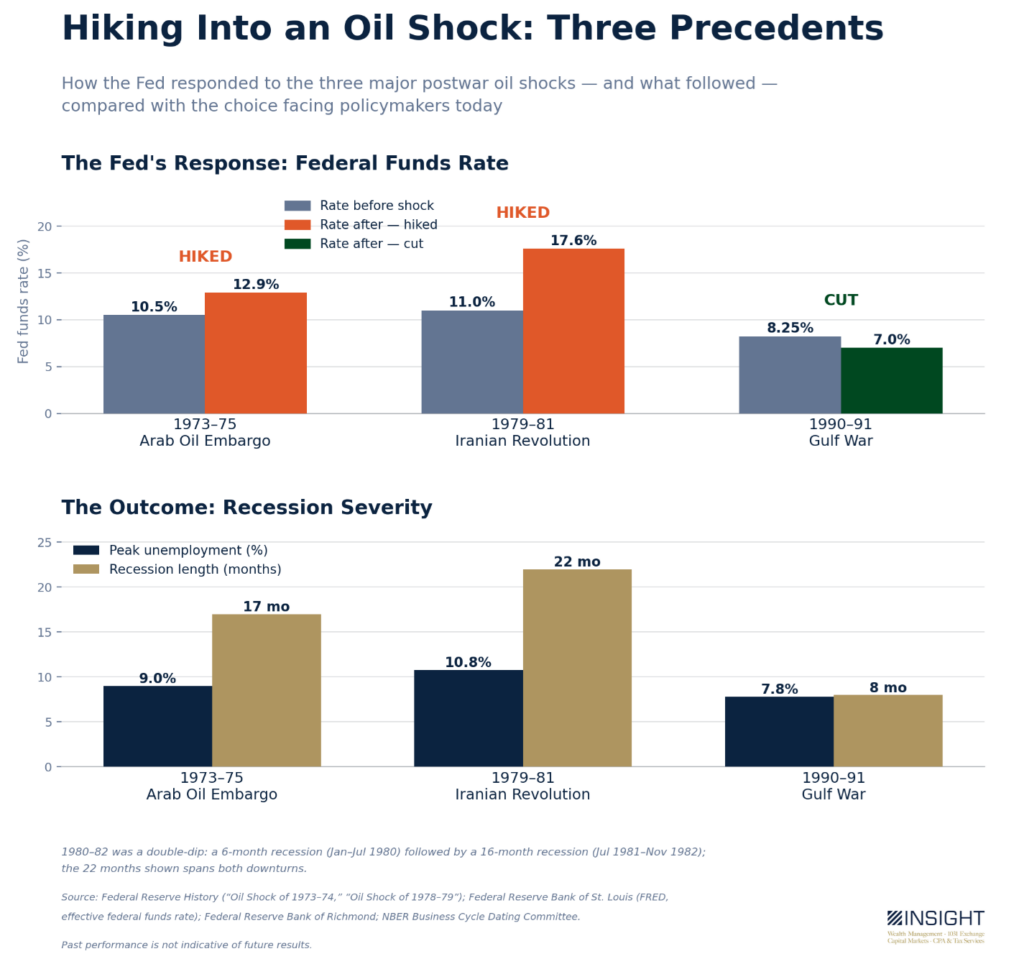
Were those recessions caused by the Fed? No. They were caused by the doubling of energy prices. But raising rates into the problem – trying to limit demand – didn’t benefit anyone.
The First Hike Isn’t the Problem
The market told us exactly what it thought about this hike. While it was down on the day of the decision, the market closed the week up. Friday’s close was 1.3% higher than Wednesday’s close. The market isn’t scared of this hike. It is, after all, exactly what it wanted.
The first hike shouldn’t scare us either. It doesn’t tell us much…yet. The real question we need to answer is if this is a “slow” rate hike cycle or a “fast” rate hike cycle. Or, if this is just a one-off “non-cycle” event.
A fast rate hike cycle is exactly what we experienced in 2022. Rapid fire hikes at every meeting with many hikes being more than a simple 0.25%.
A slow cycle is gradual. Often there is a break between hikes. On average the hikes happen every other meeting. The cadence isn’t aggressive, but it’s meaningful.
The change in impact is significant, especially for the next twelve months. If this is a slow cycle (or a non-cycle), rising rates will have significantly less impact. But if it’s a fast cycle? Remember 2022 – it’s not a fun ride. Average 12-month S&P500 performance over a fast cycle is -3.6%.
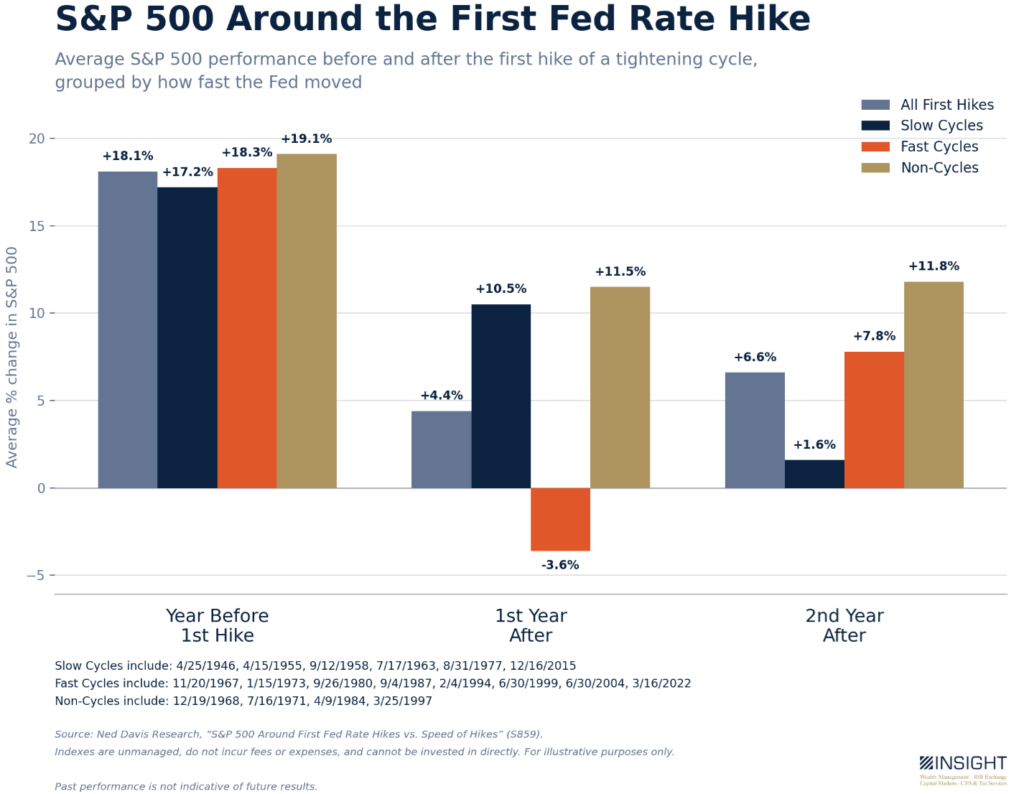
So, the real question for Warsh & Co. is just what they intend to do next. In keeping with his new mantra, he was very closed lipped. But maybe the market will decide for him like it did this time. Either way, if there is an inkling that the pace is going to be aggressive, investors should be prepared for a bumpy ride.
Sincerely,