
The Weekly Insight Podcast – A Trillion Dollar Game of Musical Chairs
There are some core fundamental philosophies we hold at Insight. One of the most important is that minimizing losses is just as important (if not more) than maximizing gains. That means we spend significant time thinking about what can go wrong in the world.
And there is no bigger “thing going wrong” than a recession. Which explains why economists and market analysts spend countless hours on TV and ink in the print media talking about when the next one is coming.
The last time we dug into this issue was April 2022 in our memo A Recession is Coming! (Eventually…). At that time, the world was screaming that the inflation and rate increases the economy was experiencing were inevitably going to cause a recession. Four and a half years later…nothing.
And here we are again, walking into a Fed meeting next week when the market is again expecting a new rate hike cycle to begin. Throw that together with rising oil prices, inflation creeping up, and the inevitable doomsday commentary in the press, and the recession conversation has returned.
But – if you put all the big brains together and asked them where we are on the path to recession – their indicators are telling a very non-doomsday story.
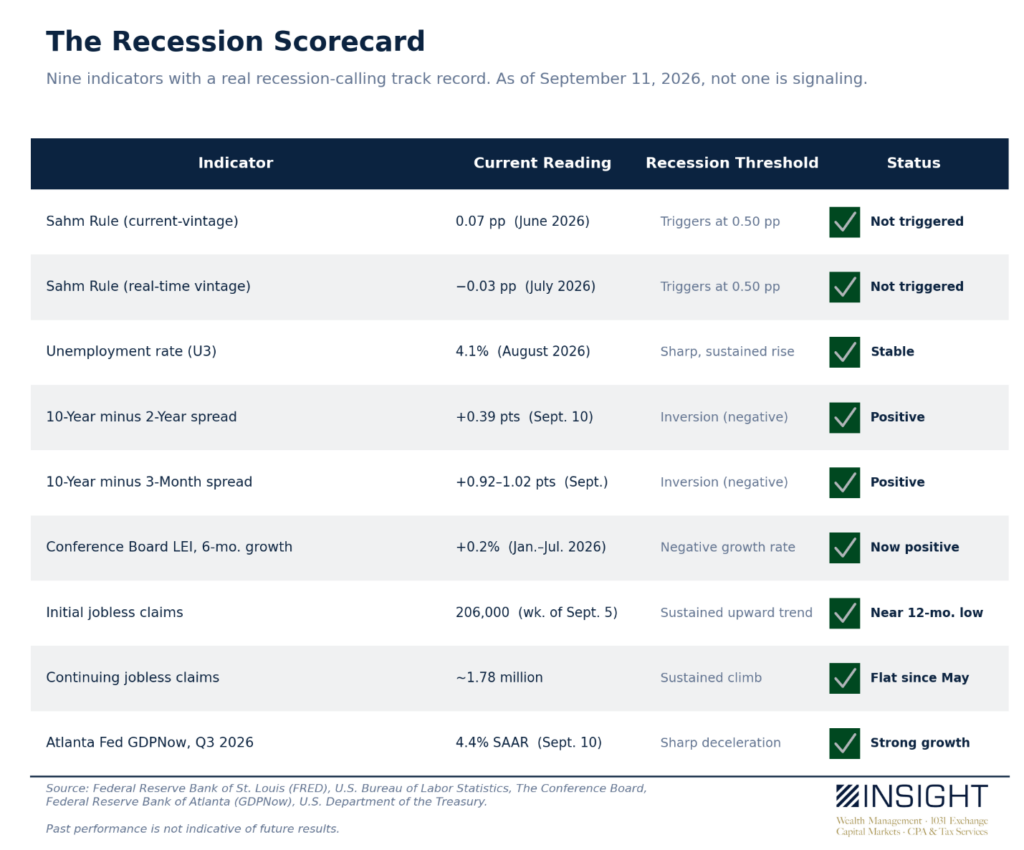
Not a single commonly used indicator of a recession is pointing that direction today.
But the indicators themselves may be a problem. Every indicator noted above is either backward- or coincident-looking by design. The Sahm Rule – which was the most recent “Gold Standard” recession indicator – doesn’t predict a recession, it confirms one has already started. Or at least it did until it triggered in July 2024 with no resulting recession. No indicator is perfect.
Then there is the LEI six-month growth rate. It went negative for four years. Still no recession.
Or the National Bureau of Economic Research which is the organization responsible for “calling” a recession. They don’t event make a recession call until 5 – 21 months after the recession begins. What good does a recession announcement a year or two later do when we’ll all know the truth before then?
There is no perfect recession predictor. So where do we look instead?
Minsky’s Financial Instability Hypothesis
Hyman Minsky was an economics professor who spent most of his career looking back at the Great Depression and wondering what made it happen and if it could happen again? He believed economics had walked away from those questions and instead settled on an elegant version of the financial system that completely ignored what mattered.
And what, according to Minsky, was that? Private debt. More specifically, that stability in and of itself (and the easy debt that came with it) was the most important destabilizing force for an economy.
During his career, his theories were largely cast aside. It wasn’t until after his passing – during the dark days of the Great Financial Crisis – that economists started looking at his work again. Had his work laid out the basis for the most significant financial downturn of our time?
In Minsky’s view there are three financing stages to an economic cycle that matter:
- Hedge Finance: This is the period in which companies can borrow money and immediately afford to pay both interest and principal from their existing earnings.
- Speculative Finance: In this stage, companies can afford to pay the interest but must keep rolling over the principal into new debt vehicles.
- Ponzi Finance: Companies can’t even cover interest payments without new borrowing or hopes of increasing valuations. This phase assumes ever expanding growth as the justification for the borrowing.
In Minsky’s view, recessions don’t need a villain. The financing system itself creates fragility. The impetus – a war, a pandemic, a market crash – is just the trigger that starts the unwind. In 2008, the borrowing on the sub-prime market followed Minsky’s hypothesis to a “T”.
AI as Sub-Prime Mortgages?
Minsky’s framework has some solid correlations to what we’re experiencing right now with the buildout of AI infrastructure.
The Hedge Finance phase was 2022 – late 2025. Hyperscalers were funding the AI buildout from their own cash flow. They had no dependency on credit markets.
The Speculative Finance phase poked its head up late last year. This is the moment we’re in. Capex has now outrun operating cashflow. Alphabet just had its first ever quarter of negative free cash flow. Amazon has shifted to net cash outflow. Hyperscalers are on pace to issue $250 billion of debt in 2026 without the cashflow to cover it. Minsky’s ears would be perking up.
To be fair, the market took notice. It’s what we’ve been discussing in these pages for months: the previously hot Magnificent Seven names are now significantly lagging the market as everyone tries to understand what this level of debt will do to equity valuations.
The Ponzi Finance phase is the one we need to worry about. If you’ve ever seen the movie The Big Short, you’ll remember the scene where the character Mark Baum (played by Steve Carell) realizes the mortgage market is a scam. People with no income, no jobs, and no assets are getting “NINJA” loans. People own multiple homes with multiple adjustable-rate mortgages on the properties – despite having bad or no credit.
While the scene is undoubtedly dramatized, it’s an important moment to understand. Mark Baum’s character – based on real-life financier Steve Eisman – is not a dumb man. Yet he was living in an economy blind to what was happening around him. And when the blinders came off, he was branded a fool by the industry, and it was still years before the credit bubble popped.
AI capex debt is NOT the same thing. But there are analogies. Take, for example, CoreWeave. It is one of the most exciting AI companies out there.
CoreWeave makes its money renting out “compute” as the owner/operator of data centers. Its revenue is skyrocketing. What was $15.8 million in 2022 is expected to be over $12 billion in 2026.
But their capex is more than keeping pace. What was expected to be $30 – $35 billion in capex at the beginning of the year is now predicted to be $35 – $39 billion. In Q3, their interest expense alone is anticipated to be $860 – $940 million.
Interestingly, CoreWeave was recently able to issue an investment grade bond. The credit rating agencies looked at a specific contract – and the company that was leasing the data center – and were willing to rate $8.5 billion in debt – owed by a start-up – similar to the credit of massive corporations with hard assets.
That is the biggest concern at this moment. Lenders are handing massive amounts of debt to an amazing group of companies. But those companies are often new and massively interdependent.
Past performance is not indicative of future results.
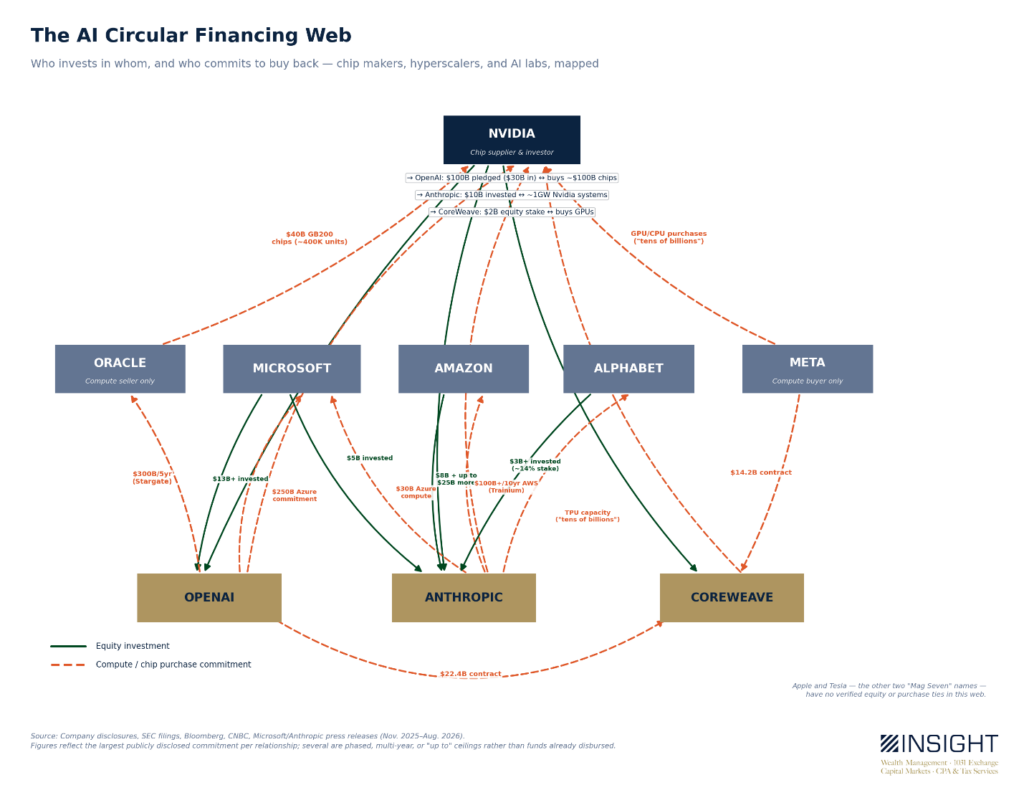
Take, for example, Anthropic. They have bought massive amounts of compute from Microsoft, Amazon, and Alphabet. But Microsoft, Amazon, and Alphabet have all turned around and invested massive amounts of equity in Anthropic. Nvidia has done the same: investing in Anthropic directly, then collecting that money back when Anthropic and its compute providers buy Nvidia chips.
Their “customer” is using their “equity” to pay them for the product they signed a commitment to purchase. And those companies are using the massive contracts they received from Anthropic to underpin debt financing that is building out the data centers that their equity partner purchased from them with money they gave them. Confused yet?
Minsky’s Final Lesson
Every time we hear the phrase “this time it’s different,” we chuckle. How often has that been said? Often. And how often has it been true? Rarely.
But that’s the argument right now for the current financing structure weighing down Wall Street. The argument for it being different is simple: AI is going to, quite literally, change the world. Profitability structures not previously imagined will be possible. The revenue potential is unlimited. This debt, the standard view says, will pale in comparison to the opportunities AI will provide.
That may prove true. And, even if it doesn’t, we’re still a long way off from the extremity of the sub-prime mortgage cycle. The major players – the Magnificent Seven at a minimum – are in the Speculative Phase. Smaller companies are starting to lean toward the Ponzi phase. But it’s not structural. Yet.
Minsky’s work tells us about recessions – not the quality of AI debt. And it shows us that, once financial instability takes root, the triggers of a recession could be almost anything.
Which is why moments like this week matter. The attacks on Saudi pipelines have the potential to finally trigger oil price spikes we’ve been warning about for months. The Fed, potentially raising rates into already high treasury yields, could be yet another catalyst.
Whether this is another Minsky moment or the start of a genuinely new world is a question only time will answer. Our job at this moment is to understand the transformational opportunity and identify opportunities to take advantage of it all while managing the risk this cyclical financing creates.
How? We attack the triggers. That’s what we’ve been writing about in these pages for months. Allocating to energy to offset the risk of rising oil prices. Holding dry powder to prepare for short- or longer-term corrections.
Until someone proves “this time it’s different,” we’ll assume it’s not.
Sincerely,