
The Weekly Insight Podcast – One Dollar Over: Why Income Planning Matters
Many – especially those receiving Social Security distributions – noticed the headline this week. The Social Security Administration (SSA) announced the cost-of-living adjustments (COLA) for next year. At 3.6%, they were the largest since 2023. For an average retiree, that will mean an additional $75/month or $900/year. For a couple, roughly $1,800 per year.
It shouldn’t come as a surprise. The COLA calculation is tied to CPI-W (CPI for Wage Earners). With gas prices driving that headline number, the COLA adjustment is just reimbursing retirees for what they’ve already spent.
So, it’s not really a raise. That’s okay because it’s not meant to be. But this jump could also create a significant income problem for our clients – especially those with large required minimum distributions. Why? A nasty little Medicare technicality called IRMAA: Income Related Monthly Adjustment Amount.
What Is IRMAA?
Many high earners already on Social Security and Medicare are familiar with IRMAA, but let’s walk through it so everyone understands. The concept is simple: once your income crosses certain thresholds, your Medicare premiums go up.
The expected baseline premium for Medicare Part B in 2027 is projected to be $209.50/month. That’s up 3.3% from 2026. That means a single payer will pay $2,514 for Medicare Part B next year and a couple will pay $5,028.
Unless a couple makes more than the IRMAA limit. While those thresholds aren’t final for 2027, they’re expected to start at $224,000 with additional step-ups in premium at $282,000, $352,000, $422,000, and $750,000.
If you go just $1 over those limits, there is a significant increase in cost. So, just imagine the COLA benefit increase pushing your household income to $224,001. In that scenario, you’d receive $1,800 more per year from Social Security, but using today’s IRMAA math, your Medicare bill will go up by over $2,000.
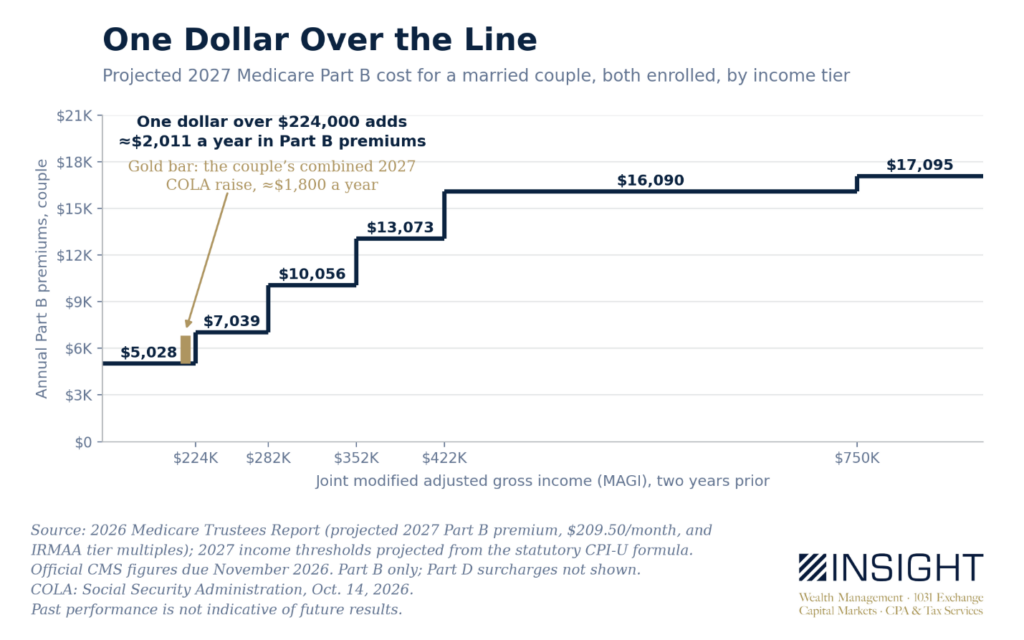
Medicare calculates your premium using your tax return two years prior to the premium year. So, for 2027, your modified adjusted gross income (MAGI) as shown on your 2025 Federal tax return is the number that will determine if you are responsible for an IRMAA payment. So, there is (almost) nothing we can do to fix next year’s problems. But now is absolutely the time to start game planning for your 2028 premiums and take proactive measures to address income levels for the 2026 tax year.
SIDEBAR: We mention there is “almost” nothing we can do. There is one thing. Taxpayers who had a “life-changing event” that led to lower income today (compared to the premium calculation year) can file a form (SSA-44) which will allow you to appeal the IRMAA payment. Touch base with your tax advisor and they can help you understand if this may apply to you.
Income Planning Matters
In truth, the COLA bump isn’t the problem. Neither is too much income. Let’s not forget that’s a good thing. But there are many, many things to consider when it comes to what the right way to generate – and recognize – income is. IRMAA is just one example of the issues we must address. Taxes are another obvious one.
Which leads to a very important discussion, especially for retirees. How do you plan your income? And what strategies are you undertaking to ensure you’re maximizing your dollars while minimizing the problems too much income may create?
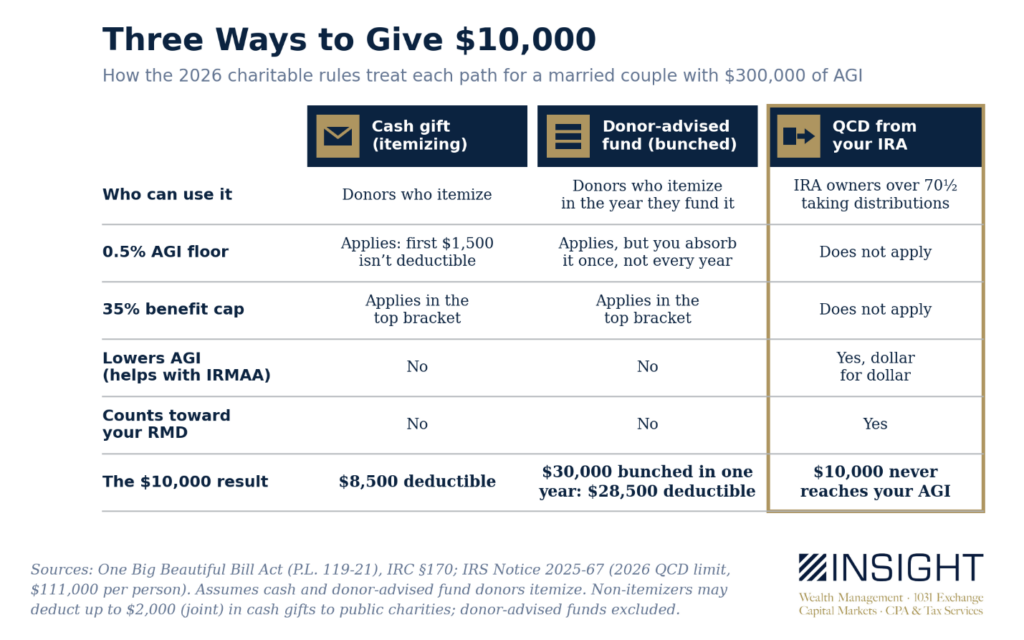
Most people immediately think “donate to charity to reduce my income!”. But it doesn’t work that way. Charitable deductions don’t reduce your income. They deduct from it for the calculation of your tax bill. That doesn’t help with IRMAA.
And the math on charitable donations is changing this year, too. The One Big Beautiful Bill has a few little-known rules that make income planning this year especially important. They include:
- Charitable deduction caps for those in the top income tax bracket (35% benefit despite their 37% income tax bracket).
- A 0.50% AGI hurdle you must clear before you can deduct charitable contributions (e.g., if your AGI is $100,000, the first $500 of charitable contributions is not deductible).
- New charitable deductions available ($1,000 single/$2,000 married filing joint) for non-itemizers. This only applies to cash gifts to public charities.
Understanding these new rules – and your income goals – means you need to be thoughtful to maximize your contributions and your tax savings.
Which brings us to the most important charitable contribution strategy for those taking required minimum distributions (RMD) from IRA accounts: the Qualified Charitable Distribution (QCD).
A QCD is a distribution directly from your IRA to a qualifying charity (e.g., your church). It counts as part of your RMD – but doesn’t count as income to you. Given the new rules, it’s more powerful than donating directly to the charity and can keep your income down to lower taxes and – if possible – avoid things like IRMAA.
Where Plans Collide
Long-term tax planning, estate planning, charitable giving, and many other items can collide around the same issues as IRMAA. Yet there is something about a five-figure surcharge that makes even the smartest investors question the potential six-figure benefits of real long-term planning.
Take Roth conversions. Often – for those who have retired but are not yet ready for required minimum distributions – Roth conversions can have significant tax and estate planning benefits. But they also create income that counts directly toward MAGI. It means higher taxes and significant IRMAA payments.
Without understanding the full picture, you may assume this means a Roth conversion is a bad idea. Let’s look at an example. Assume we have the following:
- Married couple, both 65 and recently retired.
- Both have enrolled in Medicare.
- Income is only from Social Security and is $80,000/year.
- They have a combined $5MM in IRA balances.
- They both expect to live until 95.
Given the current rules, they have until 75 before they start RMDs. Let’s assume they decide to max out the 24% tax bracket and complete Roth conversions of $371,050 per year for ten years, ages 65 – 74.
The long-term benefits (as noted below) of such a plan can be quite powerful. But the immediate tax bill can be intimidating. And the IRMAA expense over that decade? It will add $107,000 in additional expense. That can scare many retirees off.
But should it? Let’s look at the math.
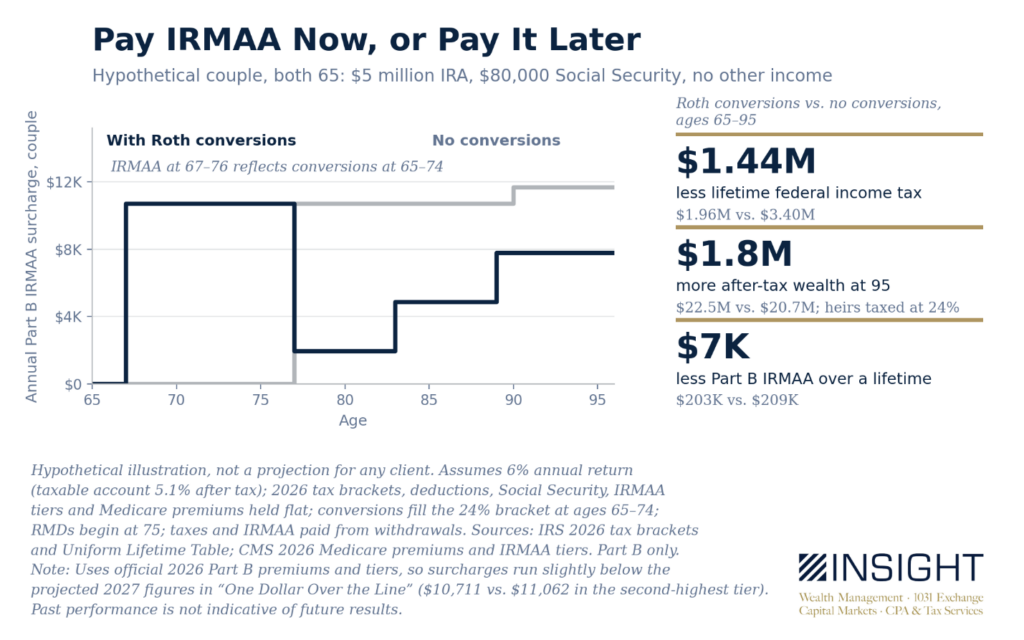
It turns out – despite the scary bill – the math still works. Even if they don’t make the conversion, the couple will still pay $209,000 in IRMAA anyway – just later. But the conversion saves $1.44MM in taxes over their lifetime. And it moves $1.8MM more to their heirs after taxes.
That’s part of the problem with these discussions. Investors inherently lean toward loss aversion – or in this case, expense aversion. They learn about IRMAA and see it as a wall. It’s not. It’s just a price. And it may be a price – once you run the math – that is well worth it.
Plan Now – Not Next Year
This is the time to dig into these issues. What has your income been outside of investments? What gains, losses, and taxable income will your portfolio create this year? What RMDs do you have? Do you have charitable goals? Does completing a Roth conversion make sense?
In the end these questions come down to two things: your goals and the math. But with less than 75 days until the end of the year, time is running short.
Now is the time to understand exactly how your income sources are impacting you. And to make a plan to ensure you’re reaching your goals. Not just accepting the consequences. Don’t let your income put you in a position you weren’t expecting.
Sincerely,