
The Weekly Insight Podcast – The Price Was Always the Problem
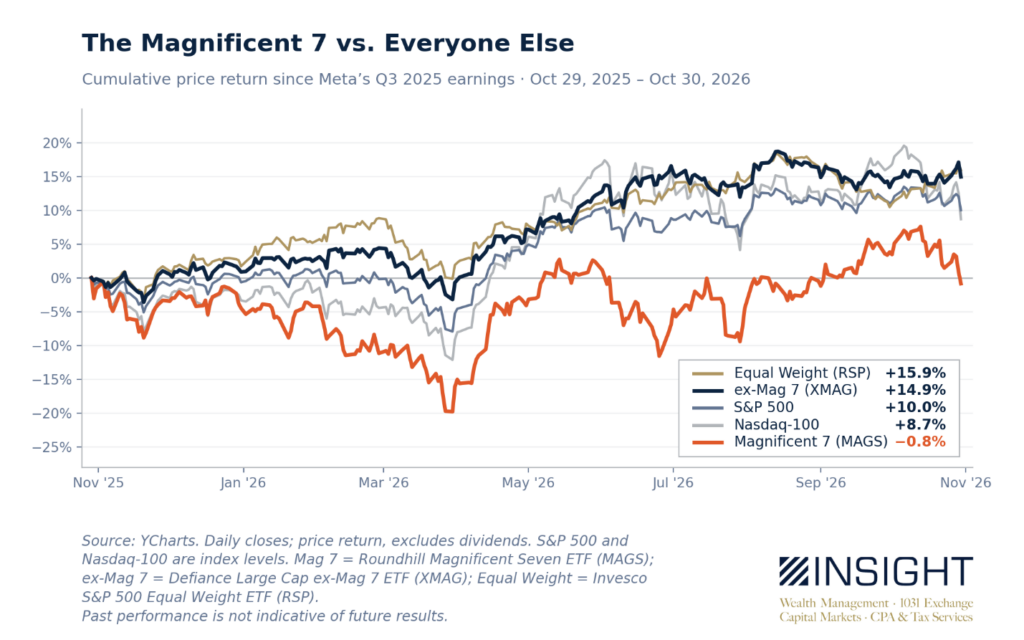
We’ve been very consistent over the last year when it comes to investing in AI. The problem has never been the fundamentals of the companies. It’s always been the price and concentration in the market to the Hyperscalers. Two headlines – 364 days apart – helped remind us of that this week.
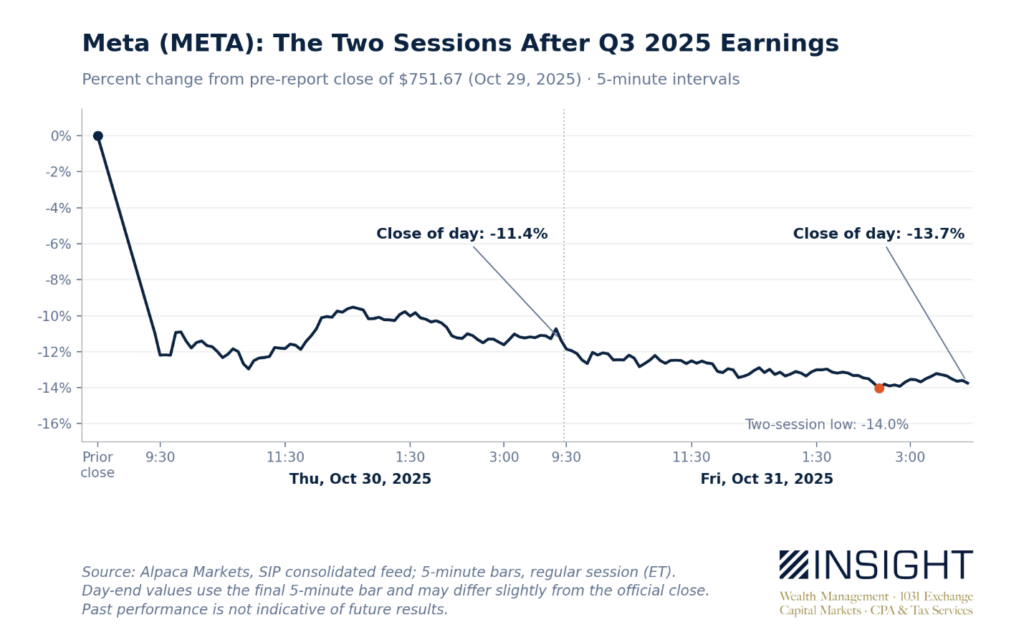
Dateline: October 29, 2025.
Meta (META) reports earnings. They announce the use of debt to fund massive CAPEX spend on AI datacenters. The market begins asking how AI can pay for itself.
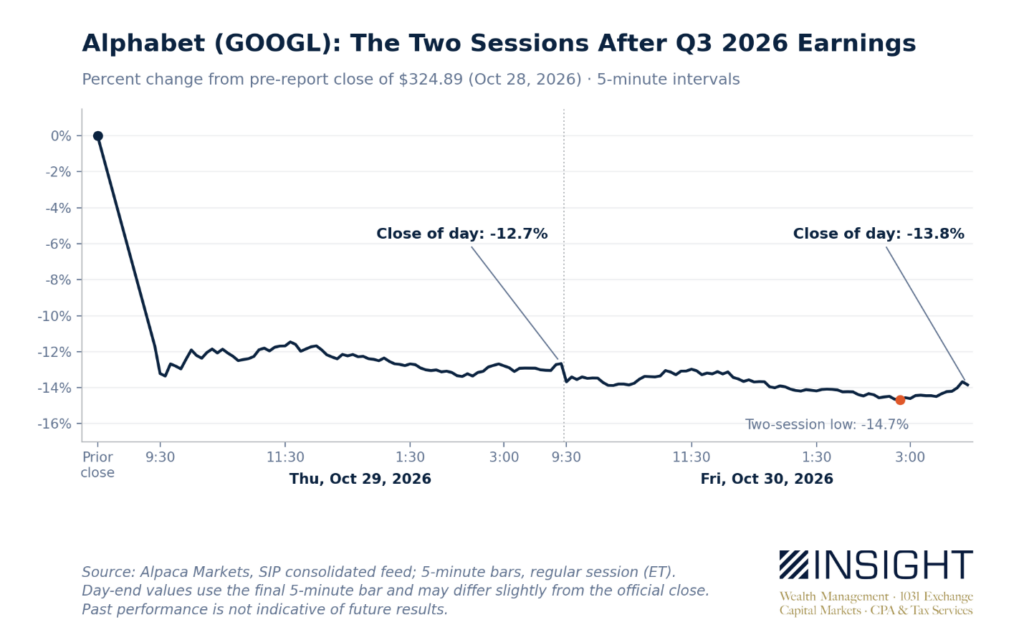
Dateline: October 28, 2026.
Google (GOOGL) reports earnings. Cites negative free cash flow (FCF) due to massive CAPEX spend on AI datacenters (its second straight quarter of negative-FCF). The market is shocked by this outcome.
We’ve Been Saying It for a While
Three hundred and sixty-four days apart. The exact same problem. Nearly the exact same result. And the world is shocked – shocked we tell you! – that this is happening.
But if you’re a regular reader of this memo, you’re not.
We called out the problem nine days before Meta’s 2025 earnings report (The Investment Risk in AI) when we noted the ROI on AI was still unclear and warned “One bad earnings report from a Google or Microsoft…could have widespread impacts.”
We identified the limits to the problem last November (What’s Going On?) when we reminded you “We don’t have a crisis. We have a concentrated stock market.” And noted that despite the downturn at the time, the non-Magnificent Seven names were holding in nicely.
We called out the opportunities in February (The Great Rebalancing) when we noted that 2026 was likely the year the “rest of the market” got to take the performance lead as AI CAPEX expectations pushed past 94% of operating cashflow for the big five Hyperscalers.
And we raised the red flag in September (A Trillion Dollar Game of Musical Chairs) when we cited Minsky’s speculative finance theory and noted that CAPEX was now outrunning cashflow.
Let’s be clear: there have been several times over the last year when our position here has come into question. The Magnificent Seven and the broader Hyperscalers led the rally after the March/Iran War pullback. And they led the charge again in September. But – broadly – the last twelve months have been dominated by the same story: underperformance by the Magnificent Seven as the rest of the market takes the lead.
What Did Google Actually Say?
The casual observer might think we’ve been saying these companies are bad investments. Or that AI is a bad investment. Neither could be further from the truth. Our problem isn’t the companies. It isn’t the sector. It isn’t the technology. Our problem is the hype. And the valuations investors have been willing to stomach.
Which brings us back to Google’s report last week. When a company as broadly traded as Google is down 13.9% over two days, you must assume the news in their earnings report was pretty scary. Let’s look at a few of the highlights:
- Revenue rose 25% to $127.6 billion in Q3, the company’s 13th consecutive quarter of double-digit revenue growth.
- Operating income rose 30% to $40.6 billion.
- Cloud revenue had record growth – rising 103% to $30.7 billion – led by AI infrastructure and solutions – with a backlog of $561 billion in future business.
Wait…what? That seems like a rather good report, doesn’t it? It is. But there were four fundamental things that raised concerns:
- Search revenue growth is slowing. Why? AI-led search is harder to monetize.
- Free-cash flow (FCF) was negative by $9.1 billion. This is the second straight negative quarter and, while they held their CAPEX target at $195 – $205 billion, they noted 2027 CAPEX would be “significantly higher”.
- The earnings number ($2.12/share) was below consensus ($3.02/share). That’s a 30% miss. But it wasn’t really. Google wrote down their SpaceX position by $8.7 billion. That means the real miss was closer to 12%. It was the same issue that led to the massive earnings beat in Q2 – but then it was growth in the value of their positions like SpaceX and Anthropic.
- The timing here was rough. It happened right after META also reported negative FCF.
What Is the Market Actually Grading?
We’d start by noting that the “miss” on search revenue growth is overwrought. Yes, search grew at 12% in Q3 vs. 17% in Q2. And, yes, it is Google’s original core business. And yes, it’s being cannibalized by their own AI search products. But their broader AI offerings – such as their Cloud revenue – are showing a path to replacing the lost Search revenue. Cloud revenue grew 103% last quarter and the expectations for the future are strong.
The earnings miss is the more interesting point. Was Google really punished for missing earnings expectations? If so, what is the standard? Because they beat expectations in Q2 and were still roundly punished.
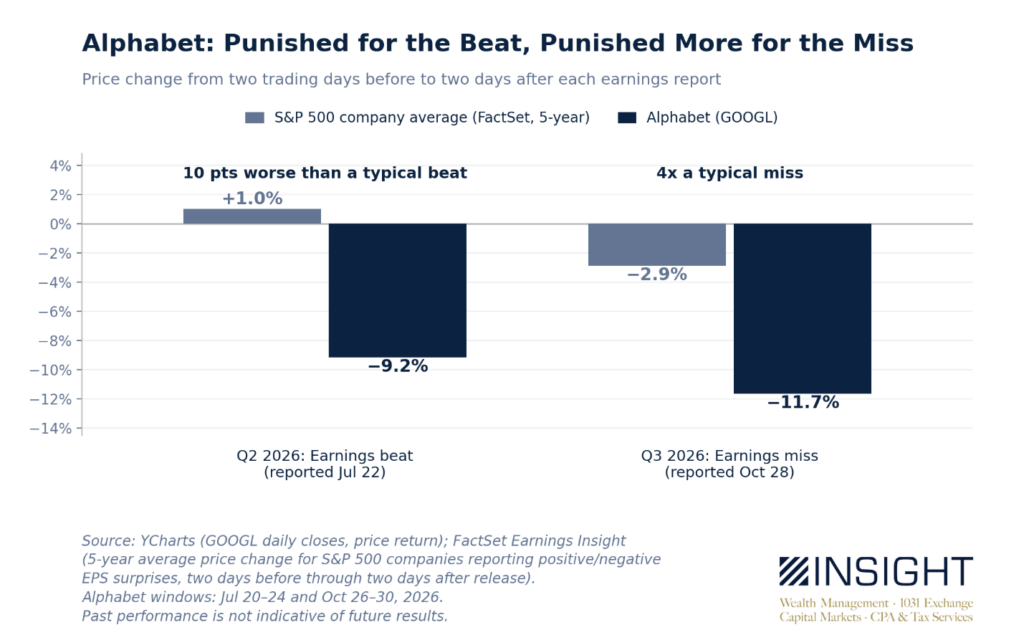
We called it out back in July (Patience is Wearing Thin) when we noted that “The market didn’t care” about Google’s positive results. The same remained true this week. Google – and the other Hyperscalers – are now being punished for the amount they are spending on AI. The market wants to know how – and when – they’re going to get paid.
That doesn’t negate the fact that Google – as a representative of the Hyperscalers – is still a massive, strong, and enduring company. They’re not going away anytime soon. But index investors – those who have been massively overweighted to similar positions for some time now – don’t really care how solid they are. They’re feeling the hit. How do we know? The Nasdaq 100 hit correction territory (briefly) on Friday while the average stock rose for the month of October.
What Are We Doing About It?
Many of you – those who participate in our Insight Dividend strategy – hold GOOGL. Our Dividend strategy is full of many “boring” names. That’s the whole point. But it does include some exposure to Hyperscaler stocks (that pay a dividend) like GOOGL, MSFT, and META.
Google is a small target weight in the strategy (1.8%). But since its inclusion in the model in June of 2025, it has been a strong performer. At the very same time we’ve been criticizing the valuations the market has created with the Hyperscalers. It’s an example of understanding the concern around the situation but also knowing we can’t ignore one of the most important sectors and companies in the market.
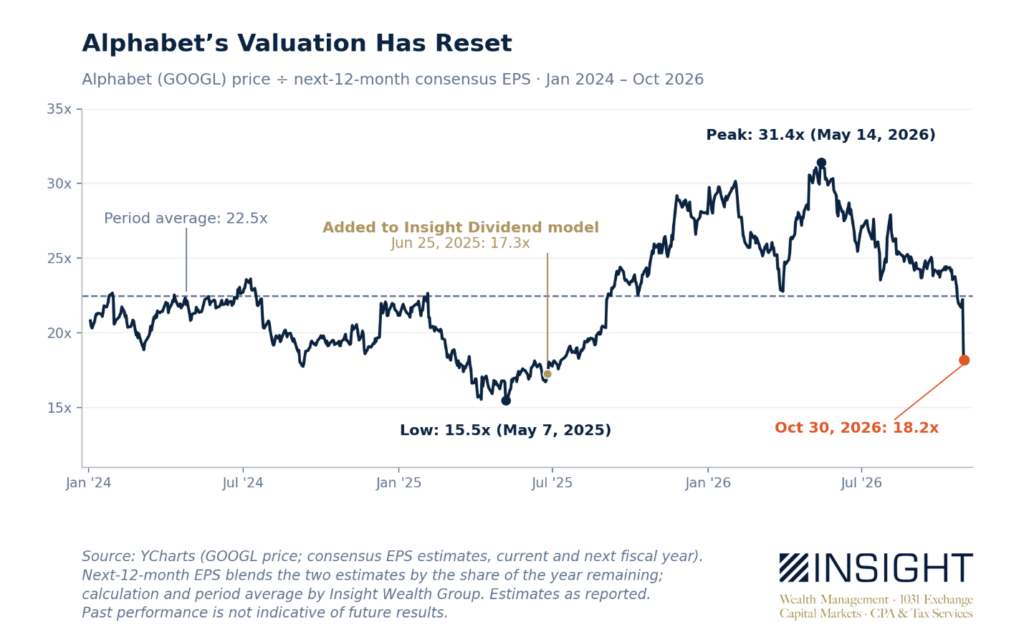
But right now, GOOGL is 30.5% off its high. That’s never fun, no matter how small the allocation is. But their share price is of far less interest to us than their valuation. And – despite being up significantly since their inclusion (the stock was trading more than $100 lower per share back in June 2025), their valuation is almost back to where we started.
Google – and the Hyperscalers – aren’t our only AI related positions in the strategy. We also have positions like Caterpillar and Cummins. Both have fallen as hard or harder than Google from their highs (down 41.5% and 31.3% respectively). That’s the same AI trade – but focused on the power generation side of the industry. Both have been strong performers since their original inclusion in the model. Both are trading at significant valuation discounts with P/E ratios below their 2024 – 2026 averages.
That means we have an interesting opportunity to take advantage of the short-term volatility. We’re rebalancing the strategy this week and – for many of you – this will mean adding to positions like Google, Microsoft, Caterpillar, and Cummins.
So, does that mean we’re convinced the worst of the AI CAPEX discussion is behind us? It doesn’t. There will be more volatility as the market comes to grips with the dramatic changes happening in the AI space.
But it does mean – for a small target weight of the overall portfolio – we’re more than comfortable adding to positions at a P/E ratio near or below our original stake.
What would change our minds about this? Three things:
- For Google specifically, does the AI-search monetization issue continue to grow without corresponding Cloud revenue to offset it?
- Do Hyperscaler credit spreads widen – meaning the bond market has more concerns about them being able to pay their debt?
- What does Nvidia’s earnings report – on November 17th – say? They’re the granddaddy of them all when it comes to the ability of these companies to maintain the scale of CAPEX.
This is what disciplined portfolio management looks like. Discipline to stick to the broader strategy (i.e., not saying “let’s ramp GOOGL to 5% because it’s so cheap!”), but also the confidence to take advantage of dislocations in the market. The companies were never the problem in our analysis. The price was.
Sincerely,