

The Weekly Insight Podcast – The American Moat
It’s about this time every two years that we draft a “what will the elections do to the market” memo. They can be useful. But we get the sense that most of you feel as we do: we just want to get this one behind us.
The campaign ads we’re seeing on TV are reflective of how the nation is feeling right now. Americans – of all political stripes – are pessimistic. Particularly about the economy.
We get it. Rising fuel prices, jumping 10-year Treasury yields, inflation creeping back up. There is always something to worry about. But are things as bad as the economic sentiment we’re seeing?
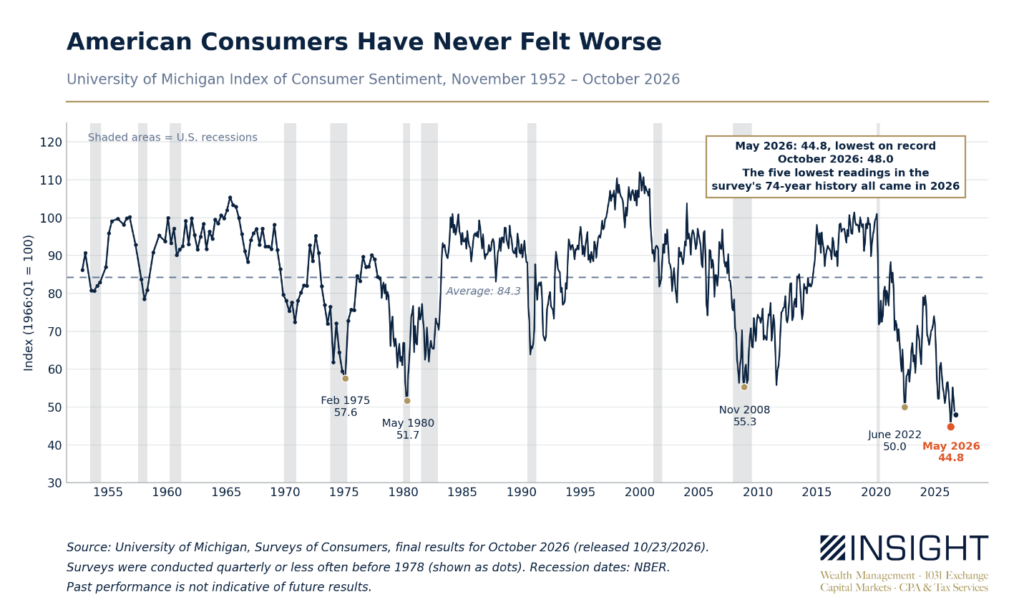
You’ll note other significant drops and low points have happened during bad economic periods. Our current free-fall started during COVID. Yes, we saw periods of recovery, but they were not sustainable. Sentiment simply hasn’t recovered and is now the lowest levels ever recorded.
Yet the economic outcomes between this drop and other similar drops just don’t match. Look at the comparison between this one and the Great Financial Crisis (GFC). At the depths of the GFC, sentiment never got as bad as we’re seeing today.
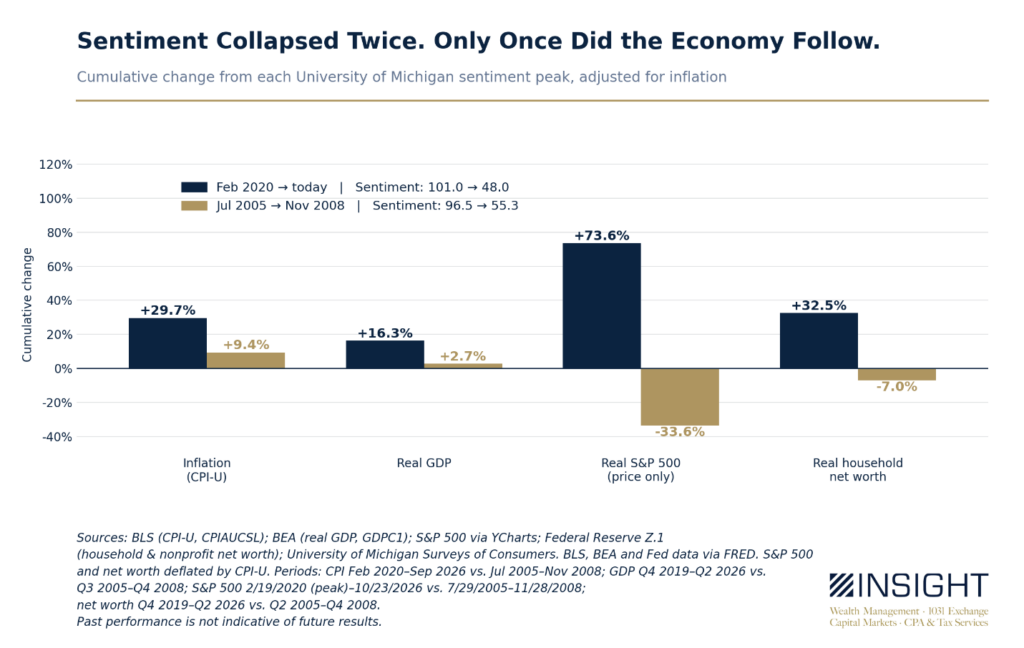
Why the disparity? Inflation is driving the sentiment gap. But every other data set above (GDP, S&P growth, and household net worth) are all inflation adjusted. Taken a step further – even when breaking it down by income percentile group – the gap is massive.
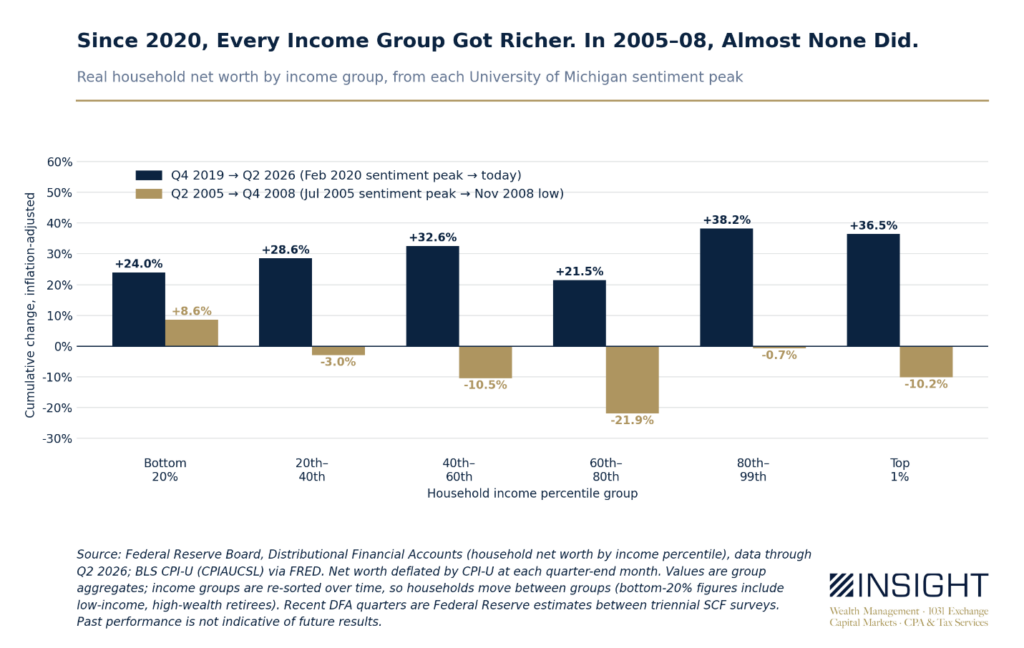
Deciphering the American psyche is well above our paygrade. But there is one thing we know with certainty: No matter the outcome, the great American collapse is not coming anytime soon.
We’re Built for This
A client sent a piece this week from Bank of America which outlined why they weren’t panicking at this moment. Their point? Foreign Direct Investment in the United States clearly demonstrates that – no matter our current view of our own situation – the rest of the world still sees us as the best place to do business.
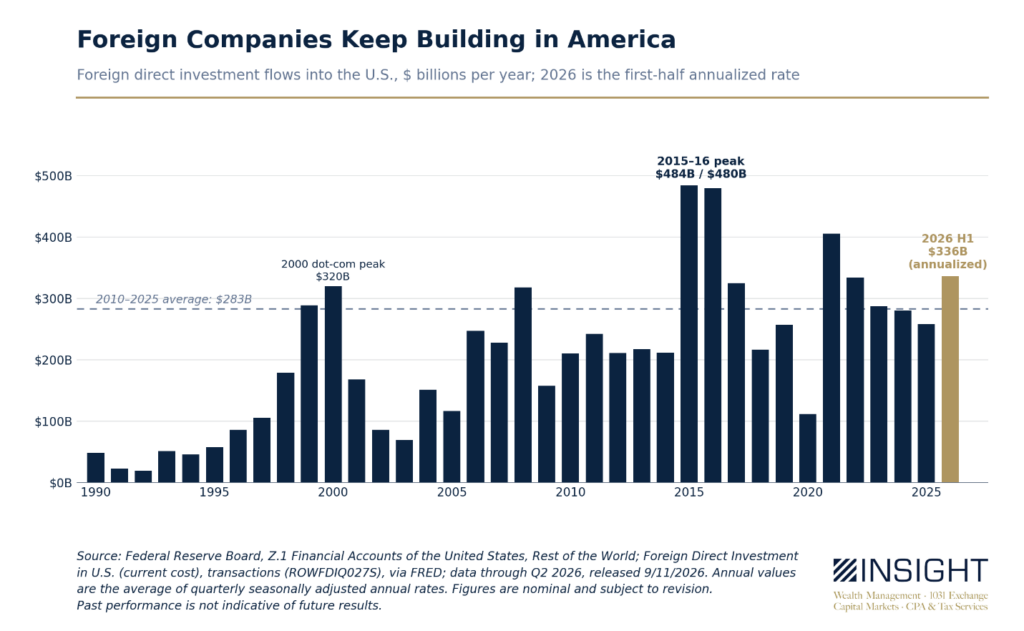
BofA is right. Those foreign investors are right. But foreign investments don’t explain the bigger picture.
The bigger picture is this: there are fundamental economic advantages we hold – as a function of our people, our history, and our geography – that are bigger than a political cycle, an economic cycle, or a foreign war. Our ancestors laid a foundation that is far more durable than we give it credit for. It’s important we all understand it.
The Geographic Advantage
“The Americans are a very lucky people. They are bordered to the north and south by weak neighbors, and to the east and west by fish. – Otto von Bismarck (19th Century German Chancellor)
Bismarck was on to something. And it has meant a level of peace and safety unheard of for a country of our stature. Since 1900, war has killed an estimated 187 million people worldwide. World War II alone killed more than 32 million in Europe. America has lost just over 600,000 men and women in that span – almost all of them on foreign soil, often helping our allies and the free world.
But our geographic advantage doesn’t end there. There are countless examples. Did you know, for instance, that America has more than 12,000 miles of commercially navigable waterways? That is one of the longest and most developed systems in the world and allows us to move freight significantly cheaper than any other method. One gallon of fuel moves one ton of cargo 576 miles by barge vs. 155 miles by truck.
That explicitly supports one of our other geographic advantages: food. There used to be a line those of us in Iowa loved about “America Feeding the World.” It’s not as true anymore as countries like Brazil have grown into real ag competitors. But we don’t need to feed the world, we need to feed ourselves. And America is the only large, developed nation in the world that produces more calories than needed to feed its population.
And what’s under the ground is equally as important. Our energy capacity is now the envy of the world. No country produces more crude oil (based on 2025 numbers) than the United States’ 13.6 million barrels per day. Russia is second with 9.9 million.
The same goes for natural gas. We currently produce over 25% of the world’s natural gas. That’s why natural gas prices in the U.S. currently hover around $3/MMBtu vs. over $28 in Europe and Asia.
America is a self-sufficient fortress. That provides flexibility no other nation possesses.
The Demographic Advantage
We wrote a whole memo about this back in January (The Biggest Thing Nobody is Talking About). The memo addressed the shrinking working age population throughout the world over the next century. It’s honestly not a pretty picture. Only Africa’s working age population will grow into 2100.
But the story in the U.S. is dramatically better than the rest of the world’s economic superpowers. Their populations are older and their birthrates are substantively lower. Take our largest economic competitor, China. They have a total fertility rate (TFR) of 1.0. You need a rate of 2.1 to have a growing population. One report expects China to lose 800,000,000 workers by 2100. That will be a catastrophic gutting of their economy.
While China’s working age population peaked over a decade ago, ours isn’t expected to peak until 2040 at 176,000,000 workers and decline to 133,000,000 by 2100, as noted in our January memo. Our TFR of 1.6 is higher, but still too low. But we’ve consistently filled that gap with immigration.
Will that continue? That’s yet to be determined. Net migration to the United States fell from 2.7 million in 2024 to 321,000 (expected) in 2026. No one is scrambling to immigrate to China, but if America’s economy continues to be strong, we will be able to attract immigration.
The Economic Moat
There was a time – not long ago – when the favorite doomsday scenario for the U.S. was that China – given their massive population – would overtake the U.S. as the largest economy in the world. Just as they said Japan would in the 1980s. Or when the EU – a group of 27 nations – surpassed our economy as late as 2011.
But here we are today, and the gap between the US and the rest of the world is as wide as it has been in over 20 years.
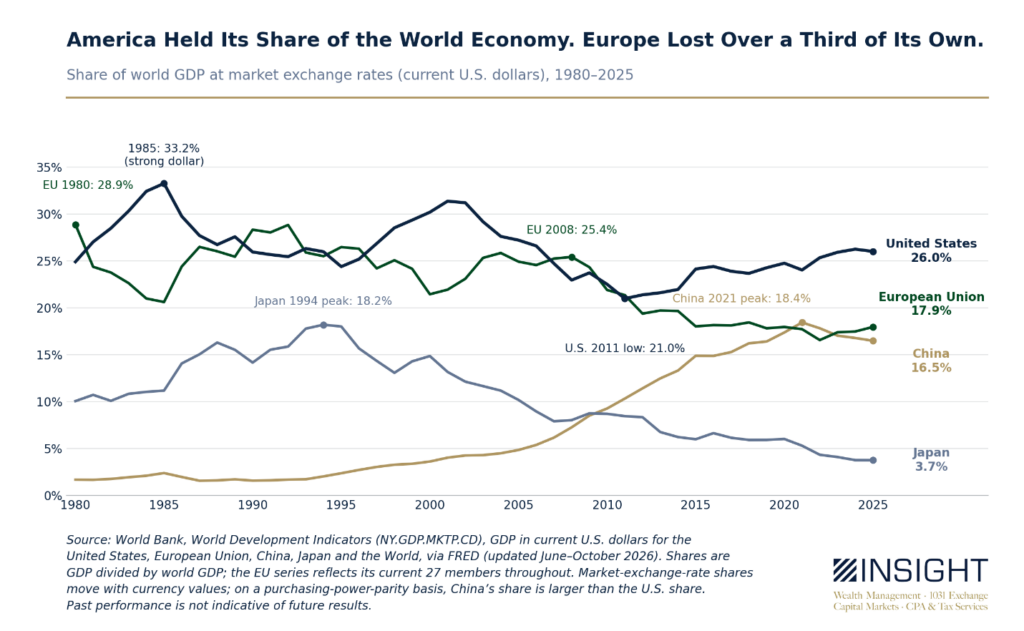
With the benefit of size also comes the institutional benefits of the world needing access to our markets.
- We have ready lenders for our U.S. Treasury bonds. $9.2 trillion is held by foreign investors.
- 56.7% of the world’s foreign currency reserves are held in U.S. dollars.
- U.S. equity markets have a market cap which makes up 43.7% of global stock market value.
We control the currency, the rules of the game, and have (by far) the biggest consumer balance sheet. Other countries may hate us. But they can’t get by without us.
Is the Moat Drying Up?
Yes. The moat is absolutely drying up. But not in the way the news would have you think. It’s drying up because no nation – ever – has permanently held on to economic primacy. Spain once held the title. So did the Dutch. And the British. None do today. It’s inevitable.
But that doesn’t mean it’s happening tomorrow. We’ve seen remarkable resilience in the American economy for the last 50+ years. Time after time we’ve been written off. Time after time, our economic might has shown through.
Take the 2008 crisis. The U.S. economy took a real punch to the gut. But GDP was back to peak in less than four years. It took the Euro-area nations seven years.
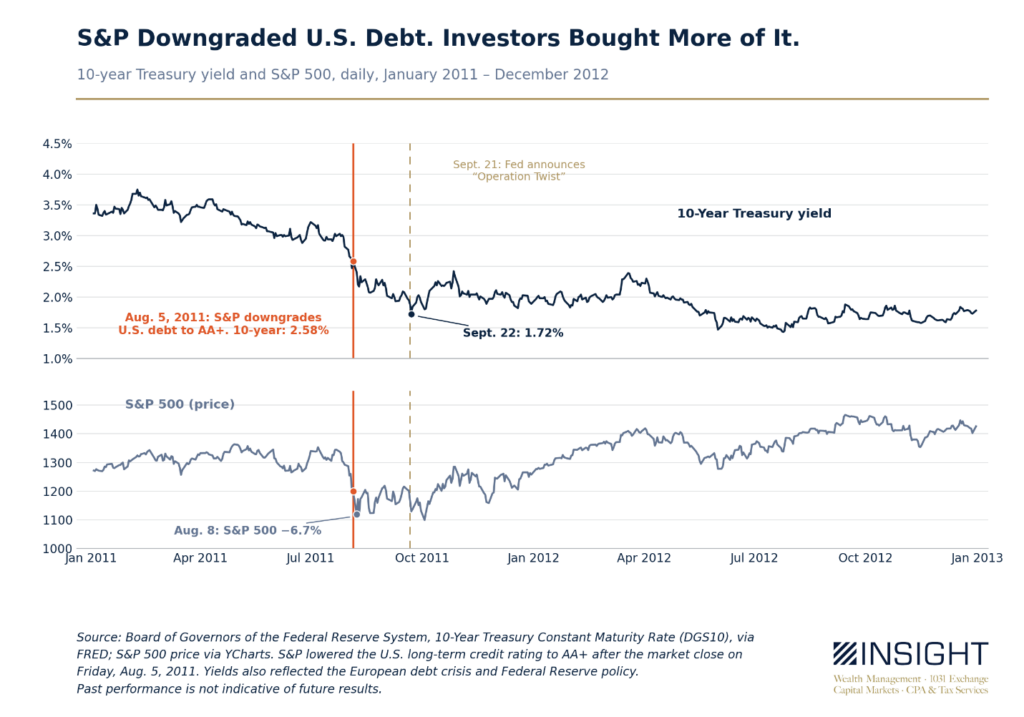
Or take the U.S. credit downgrade in August 2011. For the first time in history, S&P questioned the quality of Treasury bonds and our ability to repay them. The stock market fell nearly 7% in a single day. The end was near!
In theory, Treasury yields should have skyrocketed as our bonds were now considered “riskier” than before the downgrade. Instead, investors kept buying them and rates plummeted. They didn’t reach their pre-downgrade level until 2013.
None of this is to say we don’t have problems. We undoubtedly do. Our debt is skyrocketing. It just rose to more than 100% of our GDP and is projected to reach 120.2% by 2036. By then the interest expense alone ($2.144 trillion) will be 4.6% of GDP, more than double the 50-year average of 2.1%.
Then there is Social Security Trust Fund which is depleted in 2032.
Or the erosion of the dollar as the world’s currency.
Or the rising trade partnerships happening throughout the world without U.S. involvement.
All of these chip away at our position. But none are a screaming alarm bell predicting immediate doom. Our geographic and capital-market moats are the type that shift over generations, not election cycles. Our demographic edge – even if it is just being “not as bad as the rest” – can last decades. The nearest term problems are directly linked to the debt and a gradually rising risk premium for investing in the United States. But even that could take a decade or more to rear its ugly head.
So, while the politicians, and the news media, and the social media rabblerousers bombard you with end days scenarios for the U.S. economy, remember our moat. It’s big. It’s deep. And – if we’re smart – it buys us time to get our fiscal house in order. Even if we don’t, it can provide economic security for our nation much longer than feared.
Sincerely,