

Insight Is Moving
Before we dive into this week’s topic, we have some exciting news to share: Insight is moving!
It’s hard to believe that Insight Wealth Group has called the same location home for nearly 15 years—and Insight CPA for 10. Time flies! Over the past few years, though, we’ve simply outgrown our space. Insight CPA even had to expand into a separate office upstairs, and we’ve missed having our entire team together under one roof.
So, we’ve been on the hunt for a space that gives us room to grow while bringing everyone back together. Earlier this month, we officially secured our new home. And because we’re apparently creatures of habit…it’s directly across the street!
There’s plenty of work ahead to make the new space function exactly the way we want it to for both our team and our clients. And with tax season quickly approaching, the exact timing of our move is still a bit up in the air. We promise to keep you informed along the way. Watch the Weekly Insight and our social media pages for updates—and a few behind-the-scenes looks—as the new space comes together.
In the meantime, it’s business as usual. There are no changes to meeting locations, mailing addresses, phone numbers or anything else. And don’t worry—our Adel and Panora locations aren’t going anywhere!
Once the new space is ready, we look forward to opening the doors, throwing a good party and celebrating this next chapter with all of you.
Until then, let’s get to work!
The Numbers Are In
Just a month ago, we sent a memo – One Dollar Over – that called out some of the important planning issues your taxable income drives. From Medicare costs to Roth Conversions, to tax bills, income planning is incredibly important for our clients. That hasn’t changed in the last month.
But now we know many of the numbers. The IRS has released the 2027 tax brackets, deductions, estate and gift tax figures, and retirement plan contribution limits. And we’ve seen a small correction in some areas of the market. Plus, the 2026 deadlines are nearing. It’s time to get to work on any year-end and 2027 planning. You can’t avoid the tax. But you can control when you pay it.
Harvesting Won’t Get It Done
We’ve always had a love/hate relationship with tax loss harvesting – the idea of selling losing securities to offset any taxable gains in portfolios. Yes, it helps with the tax costs of success. But it also relies on failure to benefit you. We’re not making investments on your behalf hoping to lose money so we can save a bit on taxes.
Which brings us to this year. Thankfully, the opportunities for tax loss harvesting are incredibly limited in portfolios. We will, of course, review clients’ portfolios for opportunities. But you shouldn’t have lofty expectations for losses to change your tax picture.
We would, however, ask you to review any portfolios outside of our control. If you have a significant loss or two, let us know and we can work with you to identify the best way to handle it.
Roth Conversions: What’s Changed
We spent some time on Roth conversions a few weeks ago. We won’t rehash the whole thesis. But there is added information available that is worth considering as you plan for 2027.
The IRS released its 2027 inflation adjustment, which came in at 3.2%. That adjustment raised the income limit on every bracket.
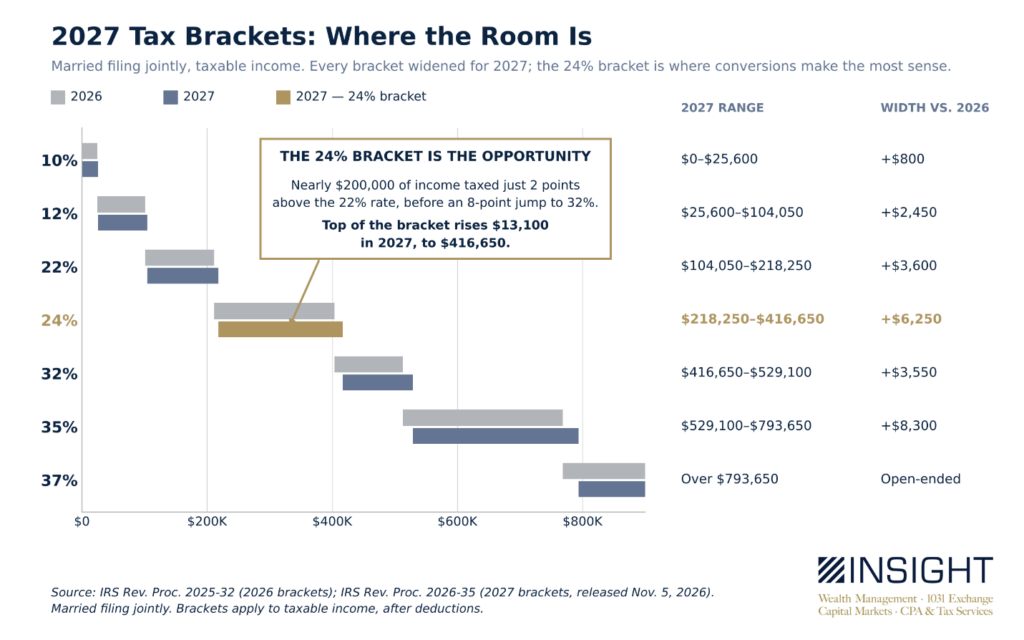
We love the 24% tax bracket. Why? It’s a cheap bump from the 22% bracket. And the top of the bracket – $416,650 in 2027 for a couple filing jointly – is a significant amount of income. The jump beyond that level, all the way up to 32%, is a big leap.
A multi-year Roth strategy will – because of the inflation adjustments – be able to convert more each year. At the top of the 24% bracket, that number is going up $13,100 next year.
We also noted we’ve seen a bit of a pullback in recent weeks in certain areas of the market. You can review our last few memos to understand we’re not suggesting a crisis in the market. Which means the lower prices – especially in Nasdaq-100 companies – create an opportunity to convert more shares for a similar dollar amount.
Which brings us to another change this month: the IRS updated the estate tax exclusion. For 2027 it rises to $15.48MM for an individual or $30.96MM for a couple.
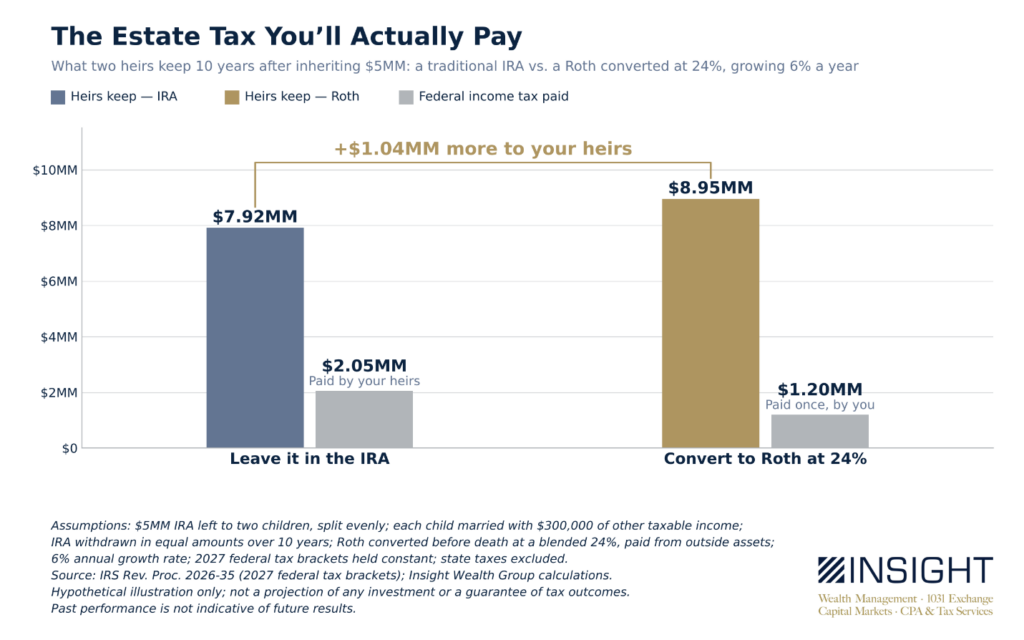
Most of you will never exceed those limits – so why worry, right? Wrong. Your real “estate tax” – the one your kids pay – is the income tax on your IRA accounts. Due to tax law changes in 2019, IRAs inherited by your kids must be liquidated within 10 years of your passing.
Many of you will pass away with significant IRA balances. Let’s imagine you die with $5MM in an IRA. That means your heirs will need to – assuming 6% growth – withdraw roughly $680,000 per year for 10 years. If your kids are high earners, they will pay more than $2 million in federal tax.
But, instead, if you convert those balances to Roth at a lower tax rate over several years – say 24% – and let it grow tax free until the end of the 10-year distribution period, your heirs keep $1.04 million more.
Important Changes for Contributions
With the new tax rates also come the new contribution limits for retirement plans. And one thing didn’t change: the contribution limits for IRAs and Roth IRAs. Standard contributions remain at $7,500 and catch-up contributions remain at $1,100.
The same isn’t true for 401(k) contribution limits. They jumped up $1,000 to $25,500 and catch-up contributions rose to $8,500.
Important reminder: for those with more than $155,000 FICA wages, all catch-up contributions must be Roth contributions. But one thing few mention? For business owners who don’t receive W-2 income, the catch-up contributions don’t need to be made in a Roth account. They can still reduce your income, no matter your income level. (Note: S-Corp owners pay themselves via W-2 wages which apply to the $155,000 limit)
Deadlines
This can be a lot to digest as we race into a busy time filled with holiday parties, family visits, gift buying, and far too much good food. So, we’re going to make it simple. Here are the important deadlines you need to remember.
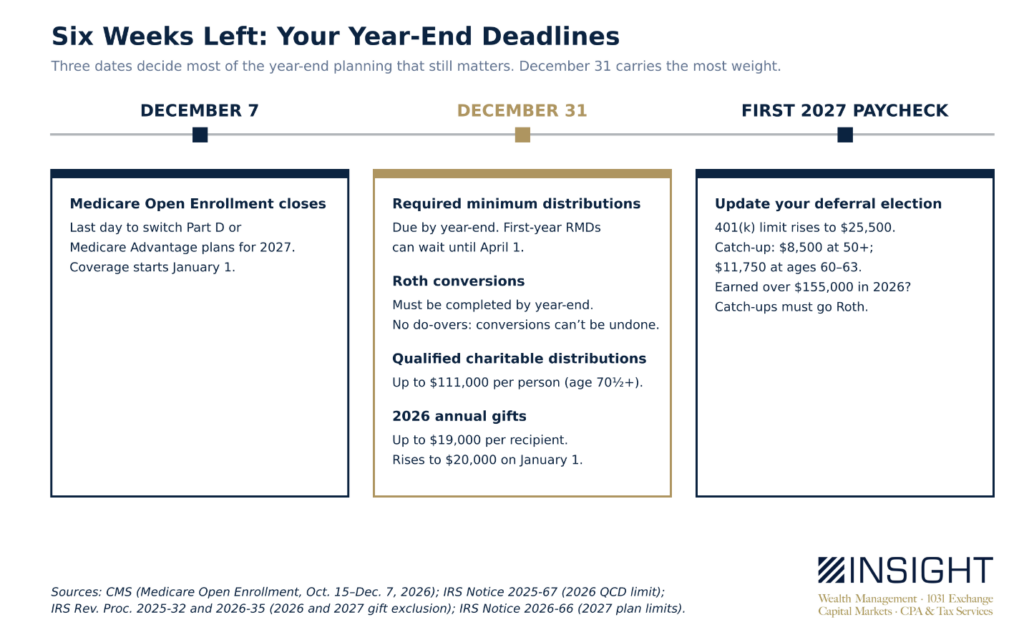
As these final six weeks rush forward, we’re here to help if you have questions or wonder if these opportunities are for you. We love hearing from you. But there is one group we need to hear from by December 1st: retirees who aren’t yet in RMD age and have income less than the max of the 24% bracket ($403,550 for married filing jointly). A Roth conversion likely makes sense. And we’re running out of time to take advantage of this calendar year. Each year that passes is one that you can’t control when you pay your taxes.
Sincerely,