

The Weekly Insight Podcast – A Political Pause, A Market Panic
As the saying goes, elections have consequences. There are many newly unemployed members of Congress understanding that statement more than ever this week.
The market felt its own consequences. And on Wednesday it didn’t hate the results. The S&P 500 closed on Wednesday, up 1.58% and the Nasdaq-100 was up 0.91%. Not bad.
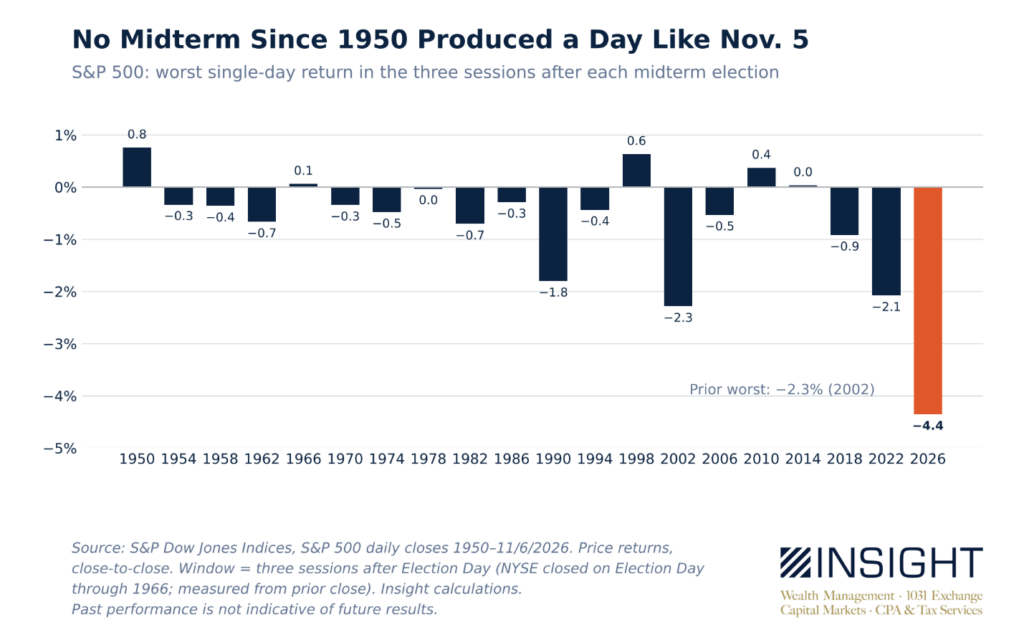
That optimism faded quickly as the markets sharply corrected on Thursday. The S&P 500 was down 4.36% (just the 57th 4%+ drop since 1950) and the Nasdaq-100 was down 6.36%. The VIX, the market’s measure of volatility, was up 69.7% in a single day. That’s the third largest single day gain since 1990.
In recent years we’ve become far too accustomed to political volatility equaling market volatility. So many of the stories moving markets have had their genesis in Washington, D.C. So, this shouldn’t be a major surprise, right? Isn’t this how markets react?
It isn’t. Not even close. Thursday wasn’t just the worst post-midterm market day in over 75 years. It was the worst by nearly 2x. Something broke.
Did Politics Break the Market?
We can answer this one quickly: no. Politics wasn’t the cause of Thursday’s pullback. It was just the trigger.
The cause is one readers of this memo are familiar with: a combination of massive overweight into one particular trade (AI) and one of the two horses of the market apocalypse: fear.
We won’t beat the AI overconcentration story to death. There are several other Weekly Insight memos you can reference for that. We’ll just cite one data point: per the Bank of America Global Fund Manager Survey in October, fund managers reported a net 37% overweight in technology, the most since August 2020. The overweight wasn’t just greedy retail investors. It was the entire institutional infrastructure of the market. And it was huge.
Here’s the problem with a crowded trade: when everyone owns the same thing, everyone needs the same exit. Hedge funds were already heading for it. Morgan Stanley’s prime brokerage data (via Steno Research) showed October’s de-risking was the largest since its records began in 2016. On Thursday, everyone followed.
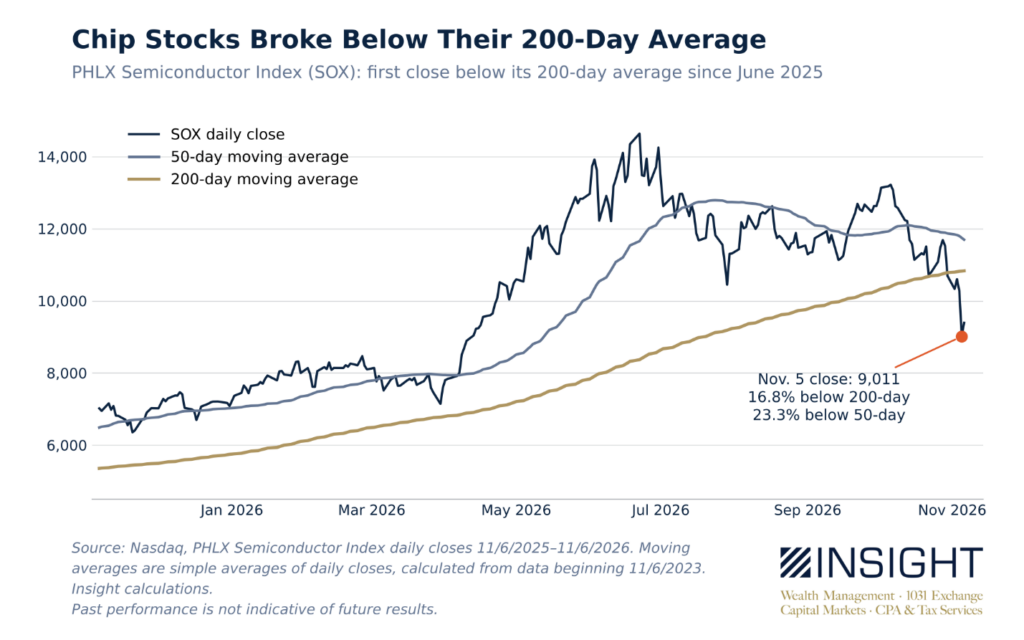
The chip stocks show it best. SOX – the semi-conductor index – peaked back in June and prior to the election was already down 27% from its high. But after passing through its 200-day moving average on October 30th, it crashed lower last week.
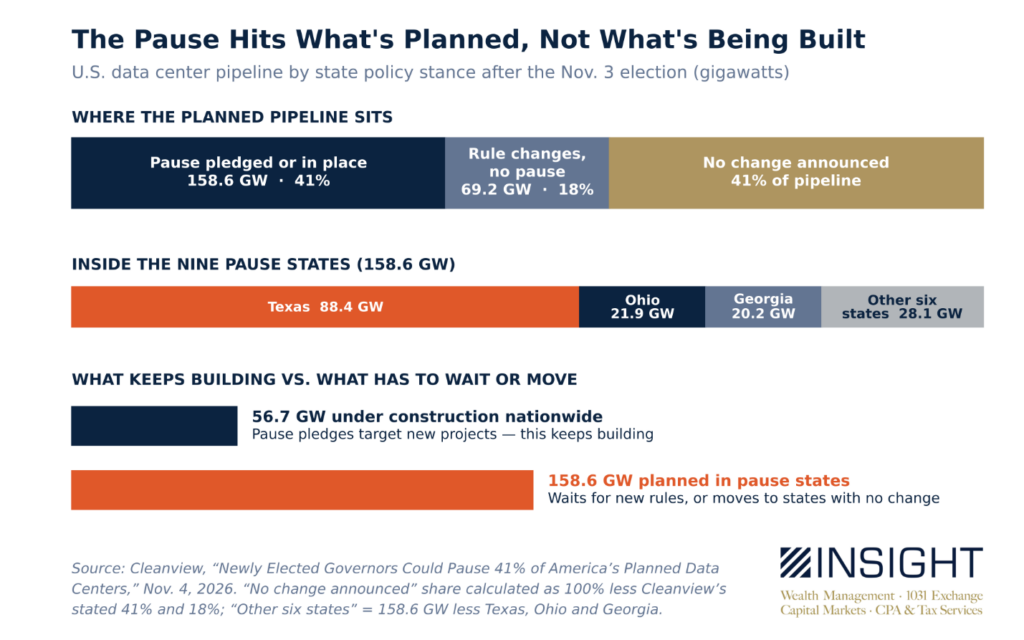
But the problem last week wasn’t spending on data centers. It was the politics around where those data centers will go.
Texas Hits Pause
Data centers have become controversial in recent months. A number of “not in my backyard” (NIMBY) complaints have been popping up. They take too much land. They burn too much energy. They use too much water. They make too much noise.
This isn’t new. For those of us in Iowa, we’ve heard these concerns about large-scale hog operations, wind towers, you name it. The same has been true of any number of new industries over the years.
But given the scale of the AI spend, the speed of the development, and the newsworthy nature of AI, this NIMBY argument is gaining ground nationwide.
Shockingly (not really), politicians jumped on this trend. And Texas – a major battleground in this election – was the epicenter of the conversation. In August and September, incumbent (Republican) Governor Greg Abbott announced an audit and permitting pause for data centers. It was wildly unpopular within the national GOP establishment and Texas’ newest trillionaire, Elon Musk.
But his opponent, Gina Hinojosa (Democrat), was even more forceful on the issue. After she defeated Abbott on Tuesday, she pledged a moratorium on all new data centers until the Texas Legislature establishes new rules in their next session.
She wasn’t alone. New governors in Ohio, Georgia, Michigan, and New Mexico all pledged to do the same. Leaders in New York, Oregon, and Wisconsin have already hit the pause button. And two yet uncalled governor’s races (Kansas and Alaska) also feature candidates who have pledged to stop development (for now).
According to research from Cleanview, nine states with existing or pledged “pauses” account for 41% of the current pipeline for new data center development. Goldman Sachs pegs the number at 45%. 158.6 GW of planned data centers are now sitting in limbo. That’s what the market woke up and realized on Thursday morning.
The Data Centers Aren’t the Problem
Let’s be blunt: we don’t buy the moratorium scare. Most of these states aren’t going to ignore the economic development opportunities around data centers. For those that do, the developers will just find other locations. Those locations may be in other states, other nations, or – if Elon Musk gets his way – in space.
The real lesson from last week was this: concentration works in portfolios…until it doesn’t. And no one – not even Warren Buffett – is smart enough to tell us the exact moment to pull the plug.
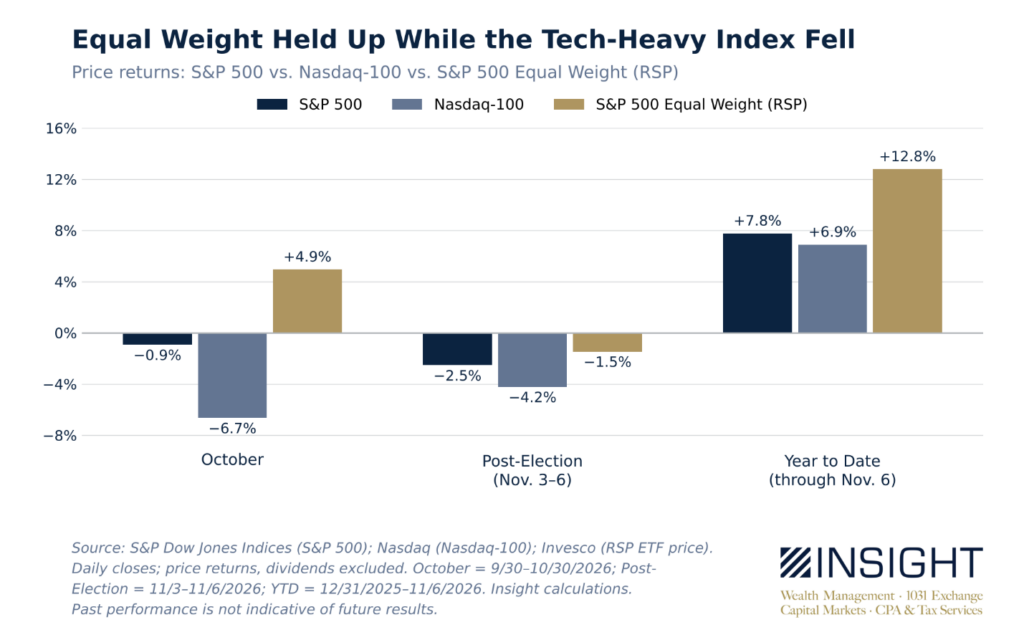
We don’t have to know the moment if we understand the broader argument. And that’s been clear throughout the year. Exposure to tech and AI names has been a drag on the market since January. Yes, there were some exciting moments. But the trend to the “rest of the market” remains unbeaten. It accelerated in October and had manageable downside last week. Equal-weight returns YTD are nearly double the Nasdaq-100.
Which brings us back to that long-ago time of…last week. You may recall our memo highlighting Google. In highlighting the company’s 30.50% tumble from its previous highs, we made the argument that their price – and valuation – was once again making them an attractive company. That must have aged like milk, right?
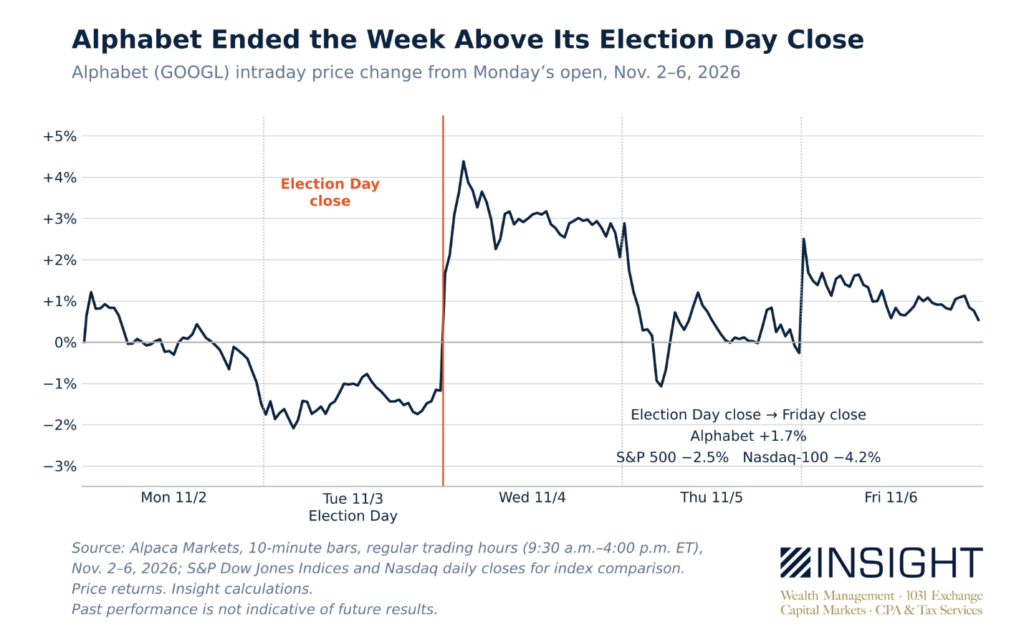
No. It didn’t. Like the rest of the market, GOOGL had a bad Thursday. But -2.3% wasn’t nearly as bad as the market. And, more importantly, it ended the week higher than it opened Monday – and higher than the close on Tuesday. A much different result than the broader market, tech indices, or the Nasdaq-100.
Why? The price had already been adjusted. Valuations were already fair. Heading into last week, Google was trading at 18.2x forward earnings. That’s cheaper than the S&P 500’s 18.7x forward P/E as of October 30th (per FactSet) and well below Google’s 22.5x average since 2024.
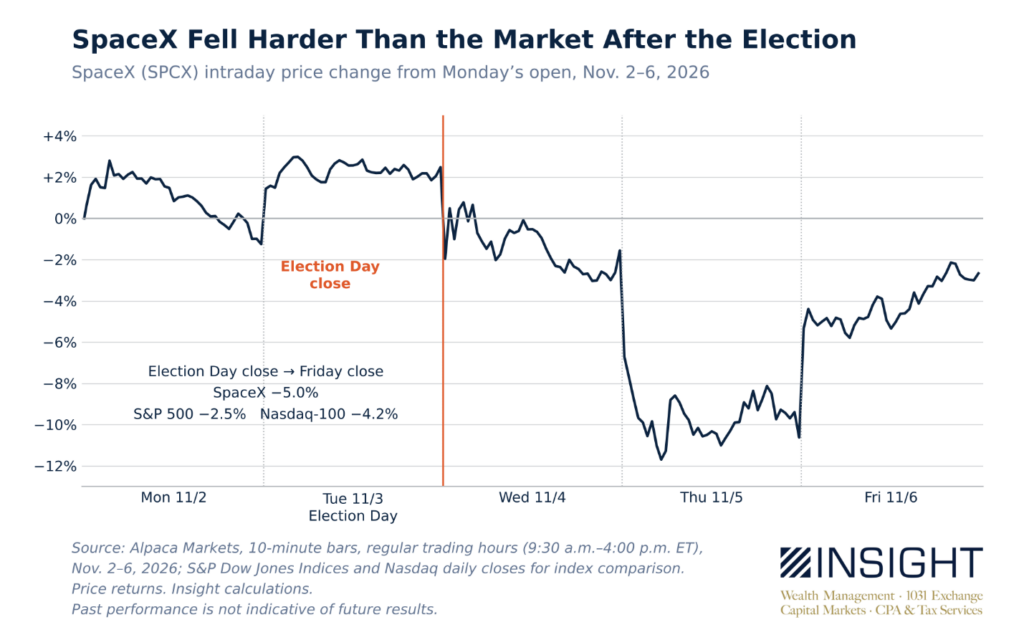
Compare that to SpaceX. A price-to-earnings ratio of 583x per YahooFinance (as of Friday’s close, with forward estimates of 255x) and a massive geographic concentration risk in…Texas. Despite a nice bounce on Friday, it had the exact opposite week of Google.
What Comes Next?
A little perspective is important in these moments. Fear and greed rule investors’ minds. They rule the financial press. And they certainly rule on social media. But the American economy, the stock market, and AI trade are much bigger than them. And they’re much bigger than any election.
AI development will continue. It may be in different locations, but it’s not stopping. And valuations will always matter to portfolio allocations. Running to popular names works in the moment, but never in long-term portfolio construction.
And, in the end, mean reversion is a real thing. Which is why days – or weeks – like we just experienced really don’t concern us.
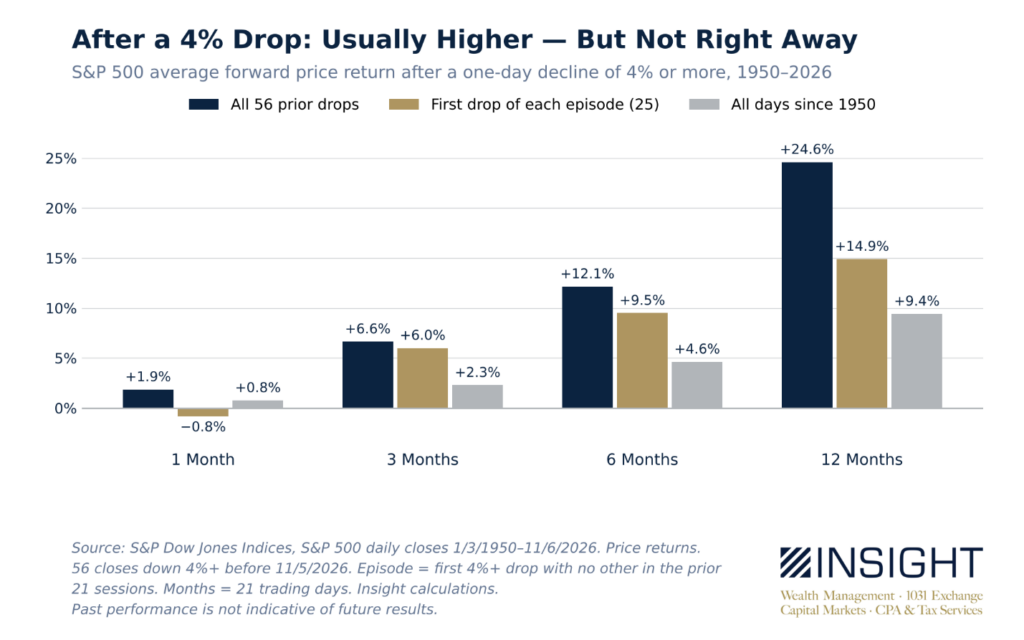
4% drops in a single day have – historically – been rare. The first 4% drop in an episode (imagine an “episode” being a moment like COVID or the 2008 financial crisis) is even more rare. But the trends are clear: the market has significantly outperformed three, six and twelve months after a 4% one-day downturn. Returns averaged more than double a typical period’s performance. Thursday is not a reason to panic.
These are the moments when it’s too late to fix the problem. Do we have tech exposure in portfolios that felt the pain this week? Of course. But we’ve already sized it down well below the concentration in the S&P 500 or the Nasdaq-100. Depending on our strategy we’re at 1/3 to 1/2 the weight in the index. That helped this week.
And we’ve surrounded that tech weight with equal-weight, value, international and energy positions. And we’ve been willing to size up tech (e.g., Google) when the price is right.
We did the work before this week happened. Now we wait to see where the political chips fall. The Texas audit on December 10th, the Texas legislative session in January, and similar machinations across the “moratorium states” will be instructive to our portfolio allocation. Just don’t buy the panic that data centers in America are doomed. They’re going up somewhere. Maybe in your backyard.
Sincerely,