
The Weekly Insight Podcast – A Discipline, Not a Decision
Editor’s Note: Just a quick reminder that, due to the Labor Day holiday, the market – and Insight’s offices – will be closed next Monday, September 7th. Accordingly, the next edition of The Weekly Insight will reach your inboxes on Tuesday, September 8th. We hope you enjoy the long weekend!
Four years ago, we wrote in these pages about former Fed Chairman Jerome Powell’s comments at the Jackson Hole Economic Policy Symposium. In these comments, which Powell purposely described as “shorter, my focus narrower, and my message more direct,” he took the stock market to the woodshed. It was this meeting where he warned everyone to buckle up, because the rate hike process – amid a bad inflationary period – was going to be painful and longer than expected.
It was one of the most consequential speeches of Jerome Powell’s tenure as Fed Chair. And it made “Jackson Hole-watching” a hot topic as the market looked to this annual symposium as an important marker in understanding the Fed’s policy path and the impact it may have on the market.
Flash forward to last Friday. New Fed Chairman Kevin Warsh stepped to the podium in Jackson Hole. Given history, it should be no surprise that the market viewed this as an opportunity to understand the future path for rates. And – whether accurate or not – they acted as if they got an answer. But we think they – yet again – missed the broader point of the speech.
Powell’s speech in 2022 was explicit. It gave forward guidance. The Fed is going to raise rates – aggressively – to counteract inflation. Hoping and praying rate cuts are coming soon is a folly. Buckle up for the ride.
To put this in perspective, the speech came after the fourth consecutive rate hike (0.25%, 0.50%, 0.75% and 0.75% respectively) that got the Federal Funds rate to a range of 2.25% – 2.50%. The market wasn’t convinced cuts were coming yet – but they were convinced rate hikes would begin to slow, and the September meeting was the place they expected that to happen (at least before Jackson Hole).
Immediately after his speech, odds of a 0.75% hike at the September 2022 Fed meeting jumped to 75%. They wobbled in the coming weeks but eventually settled in at 88% just prior to the meeting. And that’s exactly what the Fed did. And then they did it again in November. And followed that up with five more consecutive rate hikes.
Flash forward to Friday. Prior to Jackson Hole the odds of a rate hike were low – roughly 35%. By the time Warsh was done speaking, they had jumped to 60% (a smaller version of the same shock). Does that mean we’re on the same path? Or did the market miss the point entirely?
Warsh on the Economy
Before we get into the broader meaning of Warsh’s comments, let’s address what he said about the economy:
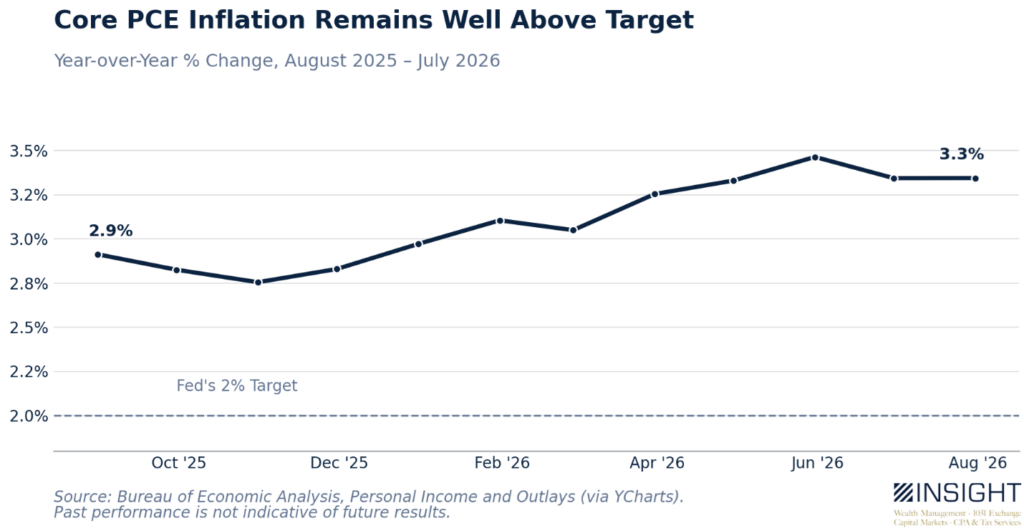
On Inflation: The most covered quote of the event was on inflation. As he stated, the good summer inflation prints “do not tell me that underlying trends have meaningfully improved.” He specifically cited PCE inflation running at 3.7% year-over-year and 4.1% annualized over the last six months. Notably, that is not the “Fed’s preferred inflation gauge” (core-PCE), but even that is well above the 2% target, sitting at 3.34% today.
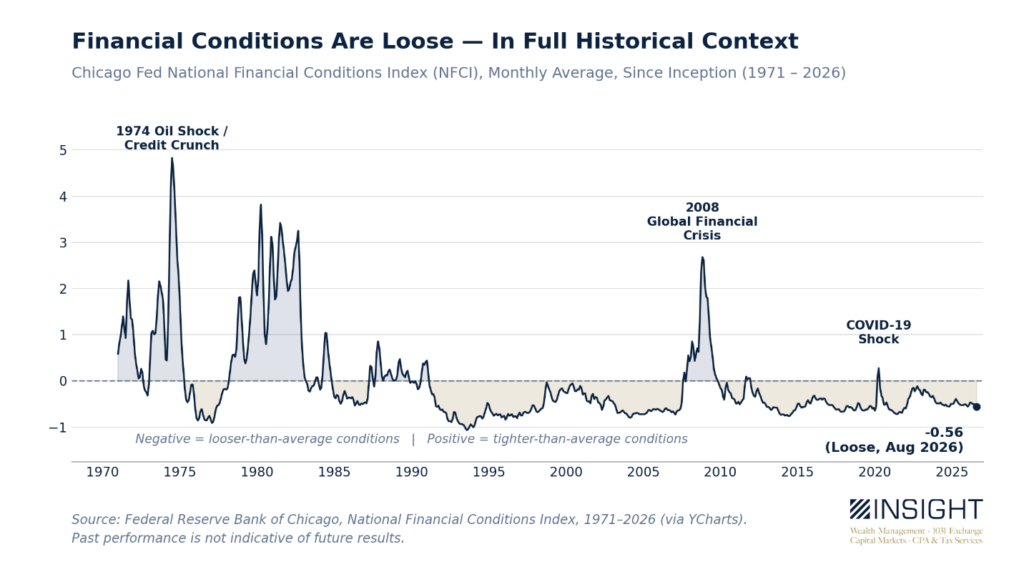
On Financial Conditions: He noted that he would “be hard pressed to describe broad financial conditions as restrictive.” And he’s not wrong. The Chicago Fed runs a “Financial Conditions Index” that is measuring how loose or tight the financial conditions in the country are. Given the “higher for longer” rate environment we’ve been in over four years, conditions are remarkably loose.
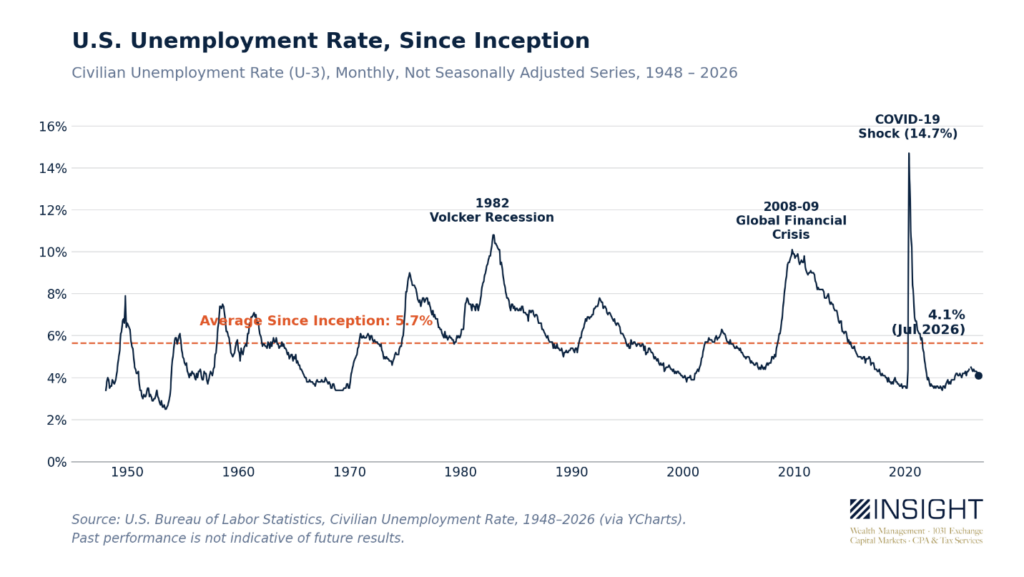
On Employment: Warsh described the current unemployment situation as “consistent with full employment.” Given unemployment sits at 4.1%, and new jobless claims are at a near decades low, he has a strong basis for this sentiment.
And that was all the market needed to hear. Inflation too high + easy financial conditions + labor market OK = rate hikes are coming.
Maybe – if you stopped listening after his economic review. But the content of Warsh’s speech was about much more than just rates.
The Meat of the Speech: Discipline – Not Guidance
Chairman Warsh thinks the Fed has been doing it wrong for a long time. He made that patently clear in his nomination hearings. He repeated it in his first two press conferences. And he dialed it up again at Jackson Hole.
What have they gotten wrong? The Fed, according to Warsh, has turned into a market research tool for the masses, providing “forward guidance” they have no business providing. Some of that is Congressionally mandated (i.e., the Dot Plot) but Warsh won’t provide guidance beyond what is required. He has even taken to excluding his opinions from the Dot Plot data so no one can get a read on what the Chair is thinking.
It’s his belief that the Fed needs to act in the best interest of the economy no matter what the market might do. And that it owes the market no insider information as it prepares to do so. No more long speeches about what the future might entail (like Powell). Just facts, data, and philosophy. As he stated on Friday: “I stand here today committed to a discipline, not to a decision.”
The market chose to read that as “a hike is coming.” It may luck into being right. But that is the short-term view. The longer-term view is “a change is coming” and no one seems to be talking about those changes as they get closer.
The New Era of the Fed
Warsh has laid out seven changes he’s going to make at the Fed. In the short term those changes will lead to more volatility around Fed meetings and Warsh speeches. Investors simply don’t know how serious he is about these changes yet. Will he stick to his guns? Will he fold when things get tough?
But overall, it should make the outcomes and expectations of the Fed much more predictable. And the market much more focused on the value of companies and the state of the economy than on the decisions of an unelected committee of bankers.
Here are the key points Warsh has laid out:
- Kill Forward Guidance: As noted above, this is the core of the agenda. He wants markets to react to actual incoming data, not what the Fed says it’s going to do. As he previously noted, this makes for a “hall of mirrors”: the Fed watches markets, markets watch the Fed, and no one pays attention to the real economy.
- Shorter, Plainer Communication: FOMC statements – at least so far – have been cut in half. No more personal Dot Plot from the Chair. The goal is to stop “spoon feeding” the market.
- Commit to a Discipline, Not a Decision: Stop pre-announcing paths. The Committee should commit to a set of principles and hold it. Meeting-by-meeting. Data dependent.
- No Soft Targets: He’s said this every time he’s spoken as Chairman. There is no soft inflation target. 2% means 2%. Until it doesn’t (more on this next).
- A Task Force Driven Review of the Fed: Warsh has brought in fifteen subject matter experts (notably not all economists!) to completely review what the Fed does and why. Is 2% the right target? Why is it the target? How will AI affect things? He’s bringing in real professionals from the real world to help answer these – and many more – questions.
- Let the Market Do Some of the Work: He’s more than happy to let the market help with rates. As he noted in July, bond yields rising on their own were evidence of tightening without the Fed having to lift a finger. He won’t shy away from that.
- Tolerate Visible Disagreement: One of the most notable things from the July meeting was the number of dissents (3 of 12) to the decision to hold rates. That is not – at least publicly – normal. Warsh is encouraging dissent and wants an open, public, and healthy debate.
The net effect so far: the market doesn’t buy it. It continues to try to interpret every word he says back to a single, binary question: will rates go up or down?
It’s going to take time for Warsh to get answers on this reimagination of the Fed. He’s stated he wants to provide clear direction by the end of the year. And it’s going to take time for the market to decide if he really means what he says.
But – if he sticks to his guns – the era of reading the Fed tea leaves may be over soon. And the market will have to adjust to a new way of doing things. That uncertainty alone will be enough to cause some volatility in the short term.
Sincerely,