
The Weekly Insight Podcast – The Cure Won’t Pay the Bills
Amidst yet another busy week in the markets, an interesting news story hit the wire. Moderna, the pharmaceutical company, announced the development of a new drug. Intismeran Autogene (they’ll come up with a much more marketable name soon) is now in Phase 3 clinical trials. It is being touted as a “vaccine” for melanoma – a common (and often deadly) cancer.
Unsurprisingly, the first “cancer vaccine” had an immediate impact on Moderna’s (MRNA) stock. And it wasn’t just Moderna. Merck, their partner in the trial, was up strongly as well. And the healthcare sector strongly outperformed the market after the announcement.
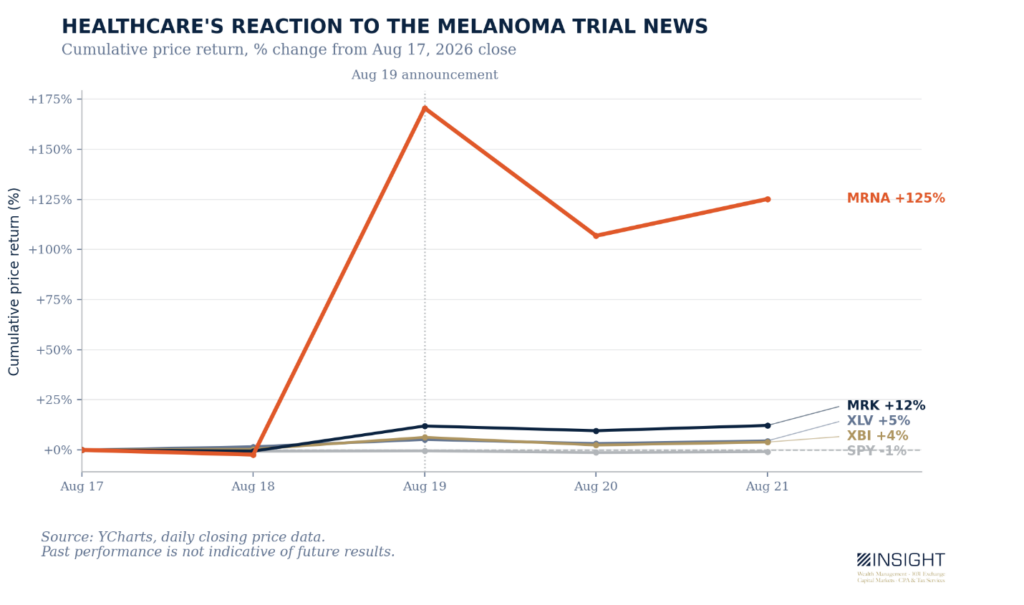
This news is – on its face – fantastic. In theory, the work they are doing with melanoma can be broadened to include other forms of cancer. And the broader idea – personalized medical treatments – could be earth-shattering. But when we hear these stories, the questions we tend to move toward aren’t ones of individual stocks , but ones of broader economic impacts. And that’s what we want to address today. But before we do, let’s look at what this “vaccine” really is and what’s coming in healthcare.
The Personalization of Healthcare
Let’s use this new Moderna drug to understand – broadly – where healthcare is going. Because it is an excellent example of the future path that AI and advancement in biotechnology is providing us today.
The Moderna drug is not – in the sense that we all understand them – a vaccine. You don’t take it in your youth to ensure you never get melanoma. Instead, it is utilized as a treatment post diagnosis.
Typically, in cases of aggressive melanoma, the treatment will include removing the tumor and then starting some type of treatment program (i.e., chemotherapy and/or radiation). Much like excising any kind of cancer, doctors know one thing: they can’t guarantee they got all the cancer cells when they cut out the tumor. That’s why they do treatment.
The problem with cancer treatments today is they are designed around the “average.” Patients receive a treatment that works on many – or most – forms of a particular type of cancer. The problem is that every single case of cancer is – in its DNA – distinct. Cancer is, at its most base level, a mutation of cells. And how those cells mutate is different in every person.
And so, the cancer treatments we have today work for some cases. Maybe most cases. But not all cases.
What this trial does differently is this: once the cancer is excised, the tumor itself is used to generate a specific and targeted drug for your cancer, not general melanoma. The “vaccine” is then given to the patient, and it trains the patient’s own immune system to attack any remaining melanoma cells.
This isn’t exactly new. Doctors at the Mayo Clinic, in conjunction with other institutions, have been revolutionizing blood cancer treatments using a process called “CAR-T” which uses the patient’s own blood to develop a custom treatment which turns the immune system against the cancer cells. Gene editing is being used to target things like heart disease, type-1 diabetes, and rare genetic diseases. Personalized cures are coming. And they’re coming fast.
The Economic Impact
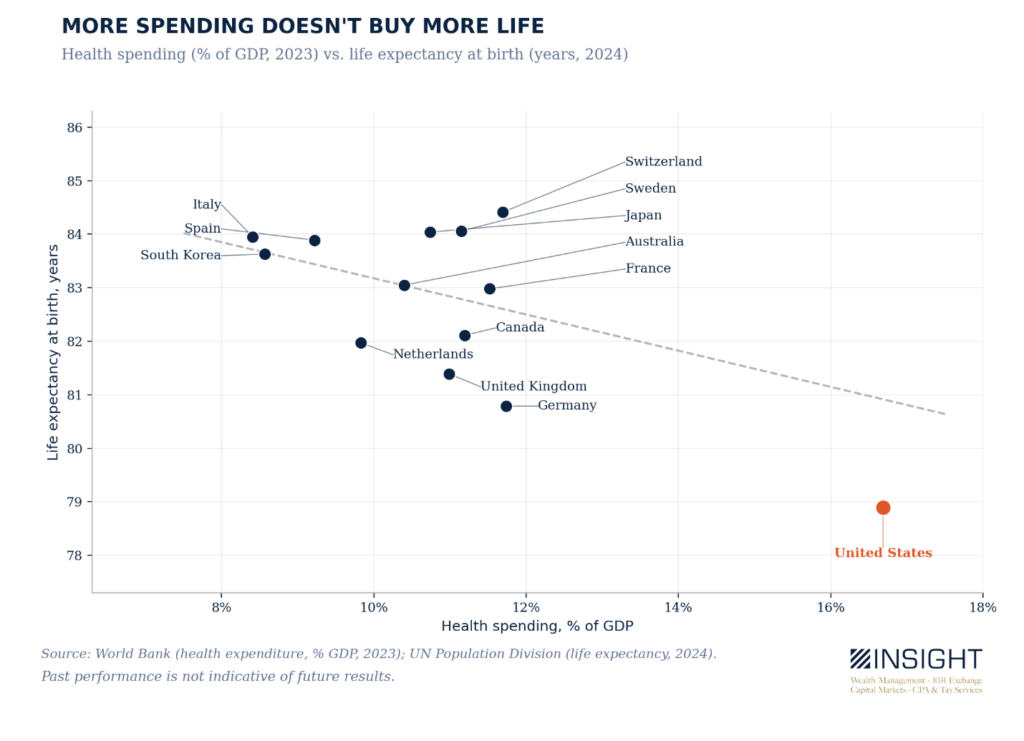
Healthcare spending in this country is, to be blunt, a problem. In 2023, healthcare costs made up 16.7% of GDP. And they’re rising faster than the economy is growing. Estimates show it will reach 20% of GDP by 2030.
Some of this is a demographic problem (a growing elderly population as the Baby Boomers age). Some of it is a systemic problem. No country in the world spends more per capita on healthcare. And our outcomes – at least as measured by life expectancy – far underperform our expense.
The excitement from last week’s announcement leads to two immediate (and premature) thoughts: 1) We can cure cancer!; 2) Think how much money that will save the economy!
OK, maybe that second one only comes to the minds of folks like us.
A cancer cure is aspirational and would positively impact so many families – nearly everyone reading this memo. But the data shows the impact economically wouldn’t be as large as many might assume. Cancer treatment in the United States makes up just 6.7% of our healthcare spend. While that is still an enormous number (estimated at more than $250 billion by 2030), even complete eradication of the disease wouldn’t solve the problem.
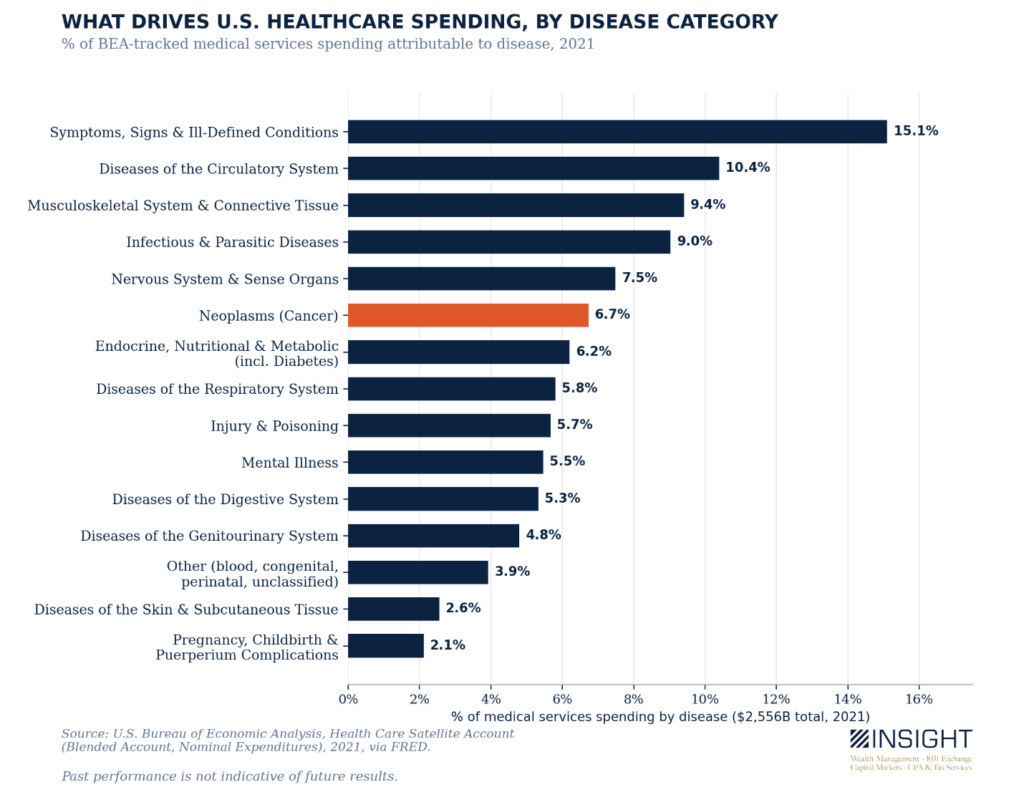
The largest spend isn’t even on a specific disease, but instead “ill-defined conditions.” Curing a disease – or even an entire category of them – isn’t going to solve the spending problem.
The Corporate Math
Earlier this year, a study called “The Economic Value of Eliminating Cancer” made the point that ridding us of the disease wouldn’t just save us the costs of treating it. Per the analysis, over the 35 years after a cure, curing cancer would avert 30.7 million deaths in the United States adding 380 million “life-years” and generating $197 trillion in economic value. That’s an average economic value of $41,684 per household per year. An 80% reduction in cancer deaths over 20 years would still capture roughly 70% of the total value – $134 trillion.
The authors of this study noted that the internal rate of return on a cure would be something in the neighborhood of 570 – 1,024% (per year!). That’s quite the return on investment.
But that return isn’t earned by the Moderna’s of the world. It’s earned by “society.” Drug companies may not be incentivized to find cures at all.
A leaked memo from Goldman Sachs written in 2018 by Salveen Richter asked this very question in a section titled “Is curing patients a sustainable business model?” He specifically mentioned Gilead Sciences’ hepatitis C cure. Their U.S. sales for the drug fell from $12.5 billion to less than $4 billion as their cure reduced demand.
But there is a counterargument. An Iowa State University study pointed out that – given the small market shares of each pharma company – developing a cure would take market share from their competitors thus adding economic value. And Gilead – the company referenced by the Goldman memo – made tens of billions from their drug. Why? The cure was patented and the patent life lasted long enough to secure almost all the economic benefits.
The good news: we’ve never been close enough to a cure like this for the “should we or shouldn’t we” conversation to even matter. Any company that cravenly delays a cure will be quickly overtaken by someone else who sees the opportunity to benefit in the short term.
The Demographic Issues of Improving Healthcare
As we noted above about the economic benefits of curing cancer, the main benefit is adding years of lifespan. The assumption is that it also adds years of consumption and production. Improvements in treatments across disease types – even if not complete cures – could materially affect life expectancy.
But will those be useful years? Will those no longer dying of these diseases be a net gain or a net loss to the economy?
This gets us into a very specific corner of the demographic world. But it’s important to understand. It’s described as two potential outcomes: a “compression of morbidity” or an “expansion of morbidity.” A brief definition:
Expansion of Morbidity: This is described as a “failure of success.” Medicine keeps people alive longer, but they are alive in a morbid state – i.e., very unhealthy, and unproductive.
Compression of Morbidity: This theory holds that as our lives improve, the morbid state compresses to end of life in a “short pre-death window” and we’re able to have longer productive lives.
Which brings us back to our 380 million added “life-years” from curing cancer. Are those years spent on the couch? In a hospital bed? Or are those years spent in the workforce? One is a drain on the economy. One is a benefit to it.
We’ve seen steep life expectancy gains before. They dominated the 20th Century. And that worked out well for the U.S. economy.
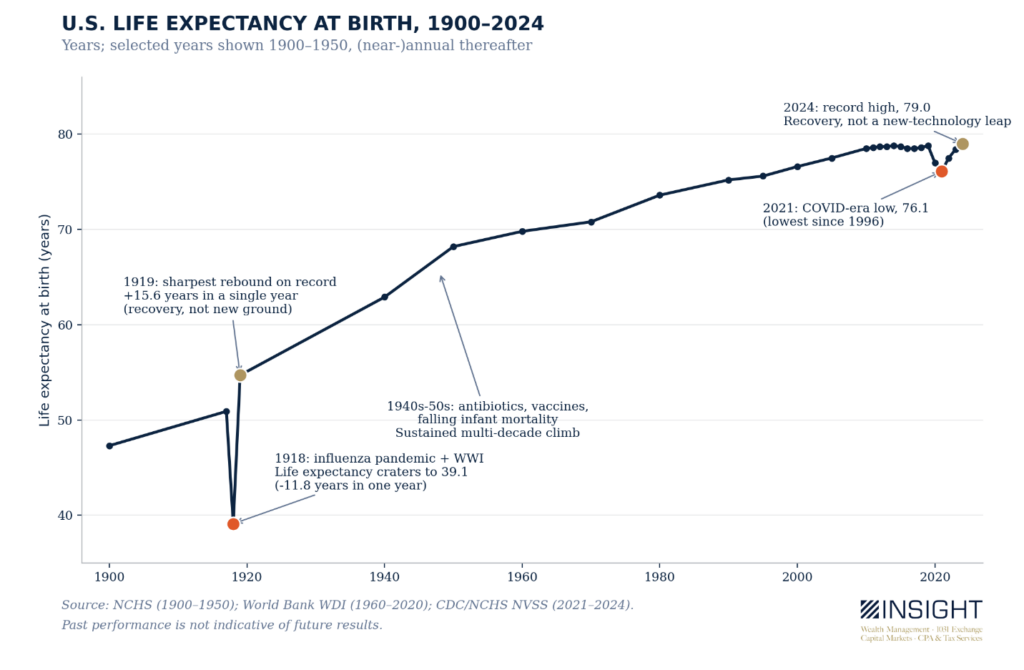
But the demographics are changing. The youngest Baby Boomer alive today is 62 years old. As of last year, Boomers made up just 15% of the U.S. labor force – already overtaken by Gen Z, a generation with wildly different retirement expectations. As Boomers achieve longer and longer lifespans while drawing from social programs and adding very less to GDP, the math may not work out the same as it did when they were the drivers of economic growth from the 1970s to 2010s.
The simple truth: most of this is still fantasy right now. The fact that we’re faced with working through these types of questions is a sign of amazing advancement.
But there is an uncomfortable version we all need to understand: the market doesn’t need “compression of morbidity” to reward these advancements. Moderna showed us that this week. It didn’t move on the promise to make people economically productive longer. It moved on a promise to sell a drug. Whether or not these medical advancements are a net gain for the economy and whether they are commercially successful are two vastly different questions.
It’s important we all remember the second and third order effects of these innovations. 380 million (or more) life years means more time with our loved ones, more experiences, more joy. But it also means more questions about how economies adapt. The winners in the next decade won’t just be the companies that cure the most disease. They’ll be the ones that get paid regardless of which way morbidity breaks.
Sincerely,